Category: Marketing

  • Domain Search: The Key Feature Behind Smarter B2B Prospecting

    Domain Search: The Key Feature Behind Smarter B2B Prospecting

    The Practical Guide to Domain Search for Better B2B Email Discovery

    Missing the right contact by one search can stall an entire pipeline. Domain search solves that by turning a company website into a fast path to verified B2B emails, helping teams prospect faster, target better, and reduce wasted outreach.

    Domain search is one of the most practical ways to improve B2B email discovery. Instead of guessing at contacts or searching manually across multiple sources, teams can start with a company domain and quickly uncover likely business emails. That makes prospecting faster, more focused, and easier to scale.

    For sales teams, SDRs, marketers, and growth professionals, domain search is not just a convenience feature. It is often the core capability that determines whether an email finder tool is useful in real workflows.

    A useful benchmark: email bounce rates above 2% are often considered a warning sign for list quality, while many deliverability teams aim to keep bounces below 1% for healthier sending reputation [1]. That is one reason domain search plus verification is more than a workflow preference—it is a deliverability safeguard.

    What Domain Search Is and How It Works

    At a basic level, domain search uses a company website domain to identify people associated with that organization and surface their work email addresses. A strong tool may combine public data, pattern matching, historical records, and verification signals to produce results.

    In practice, this means you can search a target account, review likely contacts, and move from research to outreach much faster. The best tools make the process simple: enter a domain, filter by role or department, and export the contacts you need.

    Tip: Before searching, confirm the company’s primary domain from its website footer or contact page. Using the wrong domain can return irrelevant contacts or miss sub-brands tied to the account.

    Domain-based lookup is especially effective because many organizations use predictable email formats. Common patterns include first.last@domain.com, first@domain.com, and firstinitiallast@domain.com. Even when the exact pattern is not public, pattern inference can help tools generate likely matches before verification.

    Tip: If a tool shows multiple possible email patterns, test the most common one against a verified contact before building a larger list. That can help you avoid scaling a weak pattern across an entire account.

    Why Domain Search Improves Email Accuracy

    Domain search improves accuracy because it narrows the search to a specific company rather than a broad list of names or generic addresses. That reduces guesswork and helps teams focus on relevant contacts.

    It also works best when paired with verification, since even a strong match can still be outdated. A reliable workflow is domain search first, then email verification before sending. This combination lowers bounce risk and improves deliverability. It also helps teams avoid wasting time on contacts that no longer work at the target company.

    Tip: Treat unverified results as research inputs, not send-ready contacts. Move only verified emails into active sequences so your outreach list stays cleaner.

    There is also a scale advantage: B2B data decays quickly. Research from data providers and sales operations teams commonly shows that contact data can become stale at meaningful rates each year due to job changes, company moves, and role changes [2]. That makes freshness just as important as initial match quality.

    Key Email Finder Features That Support Domain Search

    When comparing email finder tool features, look beyond the search box itself. The strongest platforms support domain search with features that improve quality and speed.

    Key capabilities include:

    • Bulk search for larger account lists
    • Email verification to confirm deliverability
    • Contact enrichment to add job titles and company details
    • CRM integrations for smoother handoff
    • Export options for sales prospecting tools workflows
    • Confidence scoring or match indicators
    • Role and department filters
    • Domain-level pattern detection

    A useful tool should also show confidence levels or match indicators so users can judge whether a result is strong enough for outreach. If a platform offers only basic lookup without verification or enrichment, it may be too limited for serious lead generation software use.

    One practical detail many teams overlook: bulk search can dramatically reduce manual work. If a rep spends even 2 minutes per contact on manual lookup, a 100-contact list can consume more than 3 hours before outreach even begins. Bulk domain search compresses that time into a single workflow.

    Tip: Use role and department filters before exporting. Narrowing by function first usually produces a smaller, more relevant list than exporting every available contact and sorting later.

    How Domain Search Improves Prospecting Efficiency and Data Quality

    Domain search helps teams work faster because it removes much of the manual effort from contact discovery. Instead of searching one person at a time, users can build lists around target accounts and roles.

    That improves efficiency, but it also supports better data quality. Clean, verified results are easier to route into CRM systems and outreach sequences. The main benefit is consistency: teams can use the same process across campaigns, which makes prospecting more repeatable and easier to measure.

    For organizations that rely on scale, this is a major advantage.

    It also supports better segmentation. For example, a team can search the same domain for finance, operations, and marketing contacts, then tailor messaging by function. That is often more effective than sending one generic sequence to a broad list.

    Tip: Build separate lists by function or seniority instead of mixing them in one export. That makes it easier to personalize messaging and measure which segment responds best.

    Common Sales and Marketing Use Cases for Domain Search

    Sales teams often use domain search to find decision-makers at target accounts, while marketers use it to build segmented lists for campaigns. SDRs may use it to support outbound prospecting, and growth teams may use it to enrich account lists before launching a sequence.

    It is also useful for account-based marketing, where precision matters more than volume. In each case, the goal is the same: find the right contact faster and with less manual work.

    Internal links can support this section well, especially to resources on lead generation strategies, sales prospecting workflows, and account-based marketing.

    A less obvious use case is territory planning. Teams can search domains across a named account list to estimate contact coverage by region, department, or seniority before launching a campaign.

    Tip: For account-based campaigns, search the same domain for multiple stakeholders, not just one primary contact. Buying committees often include several roles, and missing one can weaken the sequence.

    How to Choose the Best Domain Search Tool for Your Team

    To choose the best domain search tool, compare platforms using a simple buyer checklist.

    Start with accuracy: does the tool verify emails before you export them? Next, review coverage: does it perform well in your target industries and regions? Then assess enrichment depth, bulk search limits, CRM integration quality, and pricing.

    A strong tool should also fit your workflow, not just your budget. Here is a quick comparison framework:

    1. Basic lookup only
    2. Lookup plus verification
    3. Lookup plus verification and enrichment
    4. Lookup plus verification, enrichment, bulk search, and CRM sync

    The last option is usually the best fit for teams that need reliable prospecting at scale. Also watch for limitations such as outdated data, incomplete coverage, and false positives. Even the best domain search tools need verification before outreach.

    If your team depends on deliverability, connect this evaluation with email verification and contact enrichment resources to make the decision more practical.

    A useful buying signal is transparency. Vendors that explain how they source, verify, and refresh data tend to be easier to evaluate than tools that only advertise “millions of contacts” without methodology.

    Tip: Ask vendors how often they refresh records for your target regions or industries. Refresh cadence matters because data quality can vary by market and company size.

    Best Practices for Using Domain Search in Outreach Workflows

    Use domain search as part of a repeatable workflow, not as a one-off search tactic. Start with a target account list, run domain search, verify the results, enrich the contacts, and then push them into your CRM or outreach sequence.

    Keep your filters tight so you do not overload your pipeline with weak matches. It also helps to align search criteria with your ideal customer profile, since better inputs usually produce better outputs.

    For outreach, pair this process with cold outreach best practices so your messaging matches the contact and account context. That makes the data more useful and the outreach more relevant.

    A practical rule: prioritize verified, role-relevant contacts over larger unverified lists. Smaller lists with stronger fit often outperform bigger lists with weaker data because they reduce bounce risk and improve reply quality.

    Tip: Save your search settings for repeat campaigns. Reusing the same filters and workflow makes it easier to compare results across lists and spot what is actually improving performance.

    Useful Metrics to Track for Domain Search Performance

    If you want domain search to improve pipeline quality, track it like a system rather than a feature.

    Useful metrics include:

    • Search-to-contact match rate
    • Verification pass rate
    • Bounce rate after outreach
    • Reply rate by domain source
    • CRM sync success rate
    • Time saved per list build
    • Percentage of contacts enriched with title and company data

    These metrics help teams see whether domain search is actually improving prospecting or just creating more records. For example, a high match rate with a low verification pass rate may indicate weak data quality. A strong verification pass rate with poor reply rates may suggest the issue is targeting, not data.

    Tip: Review these metrics by campaign, not just in aggregate. A tool can look strong overall while underperforming for a specific industry, region, or persona.

    Conclusion: Choosing the Right Domain Search Tool for Reliable Email Discovery

    Domain search is a core capability in modern B2B email discovery. It helps teams find relevant contacts faster, improve accuracy, and scale prospecting without relying on manual research.

    When evaluating tools, focus on domain search quality, verification, enrichment, integrations, and coverage. The best choice is not simply the tool with the most features. It is the one that gives your team reliable results, fits your workflow, and supports consistent outreach.

    If you are comparing B2B email finding tools, make domain search the starting point of your decision.

    Final Checklist

    • Confirm the correct company domain before searching
    • Verify every email before adding it to a sequence
    • Filter by role or department before exporting
    • Track bounce and reply rates by source
    • Reuse the same workflow for every campaign

    The real advantage is not finding more emails; it is finding fewer bad ones. Start with one target account list, run domain search with verification, and measure the difference in bounce rate and reply quality on your next campaign.

    FAQ

    What Is Domain Search in a B2B Email Finder Tool?

    Domain search lets you enter a company domain and find likely business email addresses tied to that organization. It is a core method for B2B email discovery because it helps teams identify contacts faster than manual research.

    Why Is Domain Search Important for Email Discovery?

    Domain search improves targeting by connecting a company domain to relevant contacts, which saves time and supports more accurate prospecting. It is especially useful when sales teams need to build lists quickly without sacrificing relevance.

    How Accurate Is Domain Search Data?

    Accuracy depends on the tool’s data sources, verification process, and update frequency. Strong tools combine domain search with email verification to reduce outdated or invalid results before outreach.

    What Features Should a Good Email Finder Tool Include?

    Look for verification, enrichment, bulk search, CRM integrations, and clear coverage indicators. The best tools also show confidence signals so you can judge whether a result is ready for outreach.

    Can Domain Search Help with Lead Generation?

    Yes. Domain search supports lead generation by helping teams identify contacts at target accounts faster, which improves list building and outreach speed. It is especially valuable for account-based marketing and sales prospecting workflows.

    How Do I Choose the Best B2B Email Finding Tool?

    Choose a tool based on accuracy, coverage, enrichment, bulk search, CRM integration, and pricing. The best option is the one that fits your workflow, supports deliverability, and performs well in your target market.

    References

    [1] Validity — Email Bounce Rate Guide

    [2] ZoomInfo — Data Decay and B2B Contact Data Freshness

    Loading

  • Domain Email Finder Tools Explained: How to Choose the Right One

    Domain Email Finder Tools Explained: How to Choose the Right One

    The Practical Guide to Choosing the Right Domain Email Finder Tool

    Need the right business contact fast? The wrong email finder wastes time, hurts deliverability, and misses prospects. This guide shows how domain email finder tools work, what to compare, and how to choose one that improves accuracy, outreach, and compliance.

    What a Domain Email Finder Does

    A domain email finder is a tool that helps you find verified business email addresses associated with a company domain. It is commonly used by sales teams, marketers, recruiters, and founders who need to reach the right person at the right company. Unlike generic contact lists, a domain email finder focuses on business domains and B2B prospecting.

    In practice, this matters because email remains one of the highest-ROI outreach channels: Litmus reports that email marketing can return an average of $36 for every $1 spent [1]. That makes contact accuracy especially important, since even a small bounce rate can reduce campaign performance and sender reputation.

    Tip: Start with your target account list and define the exact contact role you need before searching. That keeps lookups focused and reduces wasted exports.

    How Domain Email Finder Tools Work

    Most tools start with a company domain and then search for likely employee email patterns, public records, and enrichment data. Some tools guess formats such as first.last@company.com, while others verify the result before export. The best tools combine discovery and verification so you can reduce bounce risk and improve outreach quality.

    A useful detail: many companies use only a handful of common email patterns, and tools often infer them from publicly visible addresses or historical data. Verification usually checks whether an address can receive mail without necessarily sending a message, which is why a verified result is still not a guarantee of response.

    Tip: If you already know one valid address at the company, compare its format with the tool’s suggested pattern to judge whether the result is likely to be accurate.

    Which Tool Type Fits Sales, Marketing, and Recruiting?

    Different teams need different capabilities. Sales teams usually want fast lookup, CRM integration, and export options. Marketing teams often care more about list building, enrichment, and campaign readiness. Recruiters may prioritize accuracy, role matching, and easy contact discovery. If compliance matters most, choose a domain email finder with strong verification, clear data sourcing, and controls for responsible use.

    A practical benchmark: B2B data decays quickly as people change jobs, companies rebrand, and domains shift. Gartner has estimated that B2B data decays at about 2.1% per month [2], which means roughly one in five records can become outdated in a year if not refreshed.

    Tip: Match the tool to the team’s main workflow, not just the lowest price. A sales team may need CRM sync, while recruiting may need better role filtering.

    Main Types of Email Finder Tools

    There are several categories of email finder tools. Domain-based search tools find emails from a company website or domain. Name-based tools search by person and company. Enrichment tools add missing contact details to existing records. Verification tools check whether an email is valid before you send. Many platforms combine two or more of these functions, but it helps to know which type solves your main problem.

    A less obvious distinction is between discovery and validation. Discovery tools try to identify the address; validation tools test whether it is likely deliverable. If you only need one, you may not need a full-suite platform.

    Tip: Use discovery for building new lists and validation for cleaning existing ones. That separation helps you avoid paying for features you will not use.

    Domain-Based Search vs Other Email Finding Methods

    Domain-based search is useful when you know the company but not the contact. Name-based search works better when you already know the person. Enrichment is best for improving incomplete lead records. Verification is not the same as finding an email; it confirms whether an address is likely deliverable. Understanding this difference helps you choose the right domain email finder for your workflow.

    For example, if you already have a list of 1,000 leads, enrichment and verification may be more valuable than discovery. If you are building a target account list from scratch, domain-based search is usually the faster starting point.

    Tip: Audit your current lead process first. If most of your time is spent filling missing fields, enrichment matters more than raw search volume.

    Key Features to Compare in a Domain Email Finder

    Look for accuracy, verification, data freshness, and easy exports first. Then compare pricing model, free trial availability, team-size fit, and usage limits. For many teams, CRM integrations matter just as much as search quality because they reduce manual work. Also check whether the tool supports bulk lookup, domain search, and contact enrichment. If your team runs outbound campaigns, review how the tool supports email deliverability and connects with your cold email best practices. For sales ops and pipeline teams, CRM integrations can be a major time saver.

    Other features worth comparing include confidence scoring, API access, role filters, and domain-level search depth. Some tools also show the source of the match or the reason an address was selected, which can help teams audit results before sending.

    Tip: Test the tool on a small sample of your ideal accounts and compare the results against known contacts. That gives you a realistic view of accuracy before you commit.

    Benefits for Sales, Marketing, and Recruiting Teams

    A good domain email finder can speed up prospecting, improve lead generation, and reduce time spent on manual research. Sales teams can build targeted outreach lists faster. Marketing teams can create cleaner audiences for campaigns. Recruiters can identify the right business contacts without relying on guesswork. These benefits are strongest when the tool also supports verification and workflow automation. For broader pipeline strategy, it can also support B2B lead generation efforts.

    There is also a measurable operational benefit: reducing manual research time by even a few minutes per lead can add up quickly across large outbound programs. For teams working at scale, that time savings often matters as much as raw accuracy.

    Tip: Track bounce rate and time saved during your first campaign cycle. Those two metrics make it easier to judge whether the tool is actually improving performance.

    Common B2B Prospecting Use Cases

    Common use cases include finding decision-makers at target accounts, building account-based marketing lists, sourcing candidates, and enriching inbound leads. Teams also use domain email finder tools to validate contact data before launching outreach. In many workflows, the tool sits alongside sales prospecting software and contact enrichment tools to create a more complete lead process.

    Other less obvious use cases include partner outreach, event follow-up, investor relations, and vendor sourcing. In each case, the goal is the same: reach the right person without wasting sends on generic inboxes.

    How to Evaluate Accuracy, Verification, and Compliance

    Start by checking how the tool sources data and how often it refreshes records. Then test verification quality by comparing results against known contacts. Review bounce rates, confidence scores, and whether the platform explains why an email was found. Compliance matters too, especially for teams working across regions. Make sure the tool supports responsible use, clear opt-out handling, and policies that align with your outreach process. If deliverability is a priority, pair your domain email finder with email verification tools and a deliverability review before sending.

    A useful rule of thumb: if a tool cannot explain its confidence level or refresh cadence, it is harder to trust at scale. Also remember that verification quality can vary by mailbox provider, so a tool that performs well on one domain may not perform equally well on another.

    Tip: Review the tool’s opt-out and suppression handling before sending any campaign. That helps you avoid re-contacting people who should not receive follow-up.

    How to Choose the Right Tool for Your Workflow

    The best choice depends on your team size, budget, and use case. Small teams often need a simple, affordable tool with a free trial and easy exports. Larger teams may need bulk search, API access, and CRM integrations. Sales-led teams should prioritize speed and pipeline fit. Marketing teams should focus on list quality and enrichment. Recruiting teams should look for accuracy and role relevance. Before buying, compare pricing model, free trial terms, data freshness, export limits, and how well the tool fits your current stack.

    It also helps to test the tool on a small sample before committing. A short pilot can reveal whether the platform is strong at your target industries, regions, or company sizes.

    Tip: Build a simple scorecard with accuracy, ease of use, integrations, and cost per usable contact. A scorecard makes vendor comparisons much easier.

    Quick Comparison Checklist

    Use this checklist before choosing a domain email finder:

    • Does it support domain-based search and bulk lookup?
    • Does it verify emails before export?
    • How often is the data refreshed?
    • Does it integrate with your CRM or outreach stack?
    • Are confidence scores or source details available?
    • What are the export, API, and usage limits?
    • Does the pricing model fit your expected volume?
    • Does it support responsible use and opt-out handling?

    Conclusion

    A domain email finder is most valuable when it helps you find accurate business contacts without slowing down your workflow. The right tool depends on whether you are focused on sales, marketing, recruiting, or compliance. By comparing search type, verification, integrations, pricing, and data quality, you can choose a domain email finder that supports better outreach and cleaner results.

    Final Decision Rule

    Accuracy beats volume. Pick the tool that gives you the highest share of usable contacts in your real workflow, not the one with the biggest database claim.

    Before you buy, run one pilot and measure:

    • usable contacts found
    • bounce rate after send
    • time saved per lead
    • CRM or export friction

    If the tool improves those four numbers, keep it. If not, move on.

    References

    [1] Litmus — State of Email

    [2] Gartner — B2B Data Decay Estimate

    Loading

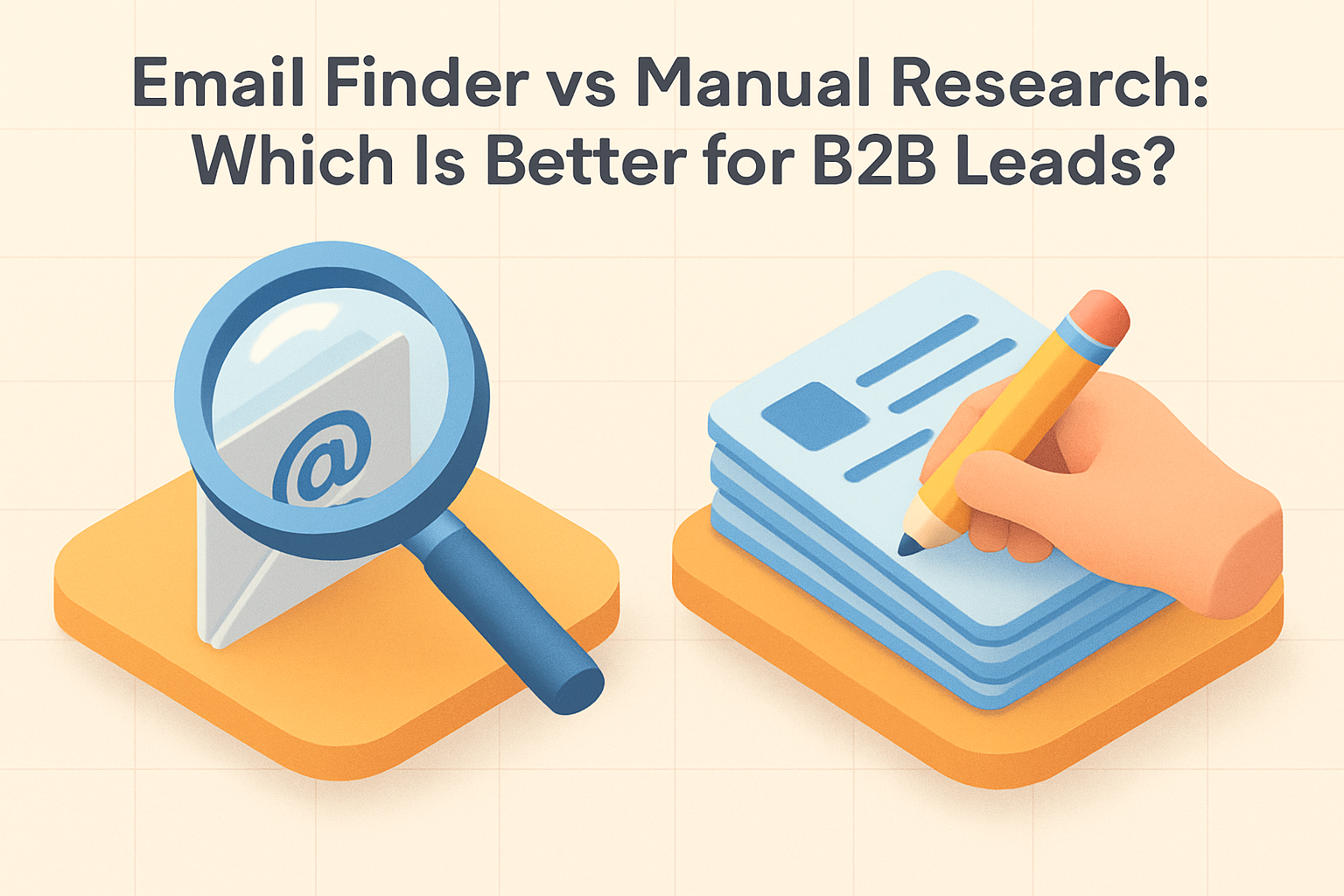
  • Email Finder vs Manual Research: Which Is Better for B2B Leads?

    Email Finder vs Manual Research: Which Is Better for B2B Leads?

    Email Finder Tool vs Manual Research: Which Is Better for B2B Emails?

    Missing the right email address can stall a deal before it starts. If your team needs to reach decision-makers, build prospect lists, or launch cold outreach, the choice between an email finder tool and manual research directly affects speed, accuracy, and results. This article shows which method fits your workflow and what you gain from each.

    Why this choice matters in B2B outreach

    B2B email remains one of the highest-volume channels for outbound sales, but inbox competition is intense. In many industries, sales teams may send dozens or even hundreds of emails per rep each day, so even a small improvement in contact accuracy can have a measurable impact on reply rates and pipeline creation. Research also shows that email continues to be a core channel for marketers and sales teams because it is direct, measurable, and scalable [1].

    Tip: Before scaling outreach, define one clear success metric such as verified contact rate or meetings booked per 100 emails. That makes it easier to compare methods later.

    What an Email Finder Tool Does for B2B Prospecting

    An email finder tool helps locate business email addresses from names, company domains, or other company data. In simple terms, it automates the process of searching for contact details that would otherwise take time to find manually. Many B2B email finder platforms also include verification features, making it easier to identify verified business emails for outreach.

    Common capabilities beyond basic lookup

    Modern tools often do more than return an address. Depending on the platform, they may also provide:

    • Domain-based search for company-wide contact discovery
    • Bulk enrichment for CRM records
    • Confidence scores or verification status
    • Role-based filtering for decision-makers
    • Export options for sales engagement tools

    These features matter because B2B data decays quickly. Job changes, company moves, and domain changes can make contact lists stale, which is why verification and enrichment are often as important as discovery.

    Tip: Use role-based filters first, then enrich the list with company data. That keeps your outreach focused on the people most likely to influence the deal.

    How Manual Email Research Works

    Manual email research usually involves searching company websites, LinkedIn profiles, press releases, and other public sources to identify a likely email address. Teams may also use naming patterns, domain clues, and trial-and-error methods to confirm contact details. This approach can work well, but it often takes more time and effort than using an email lookup tool.

    Typical manual research signals

    Researchers often look for clues such as:

    • Author bios on blog posts or press releases
    • Contact pages and media kits
    • Conference speaker pages
    • Public PDFs and investor documents
    • Email patterns used elsewhere in the same domain

    A common pattern is first.last@domain.com, but many organizations use less obvious formats. That means manual research can be accurate when the pattern is known, yet inefficient when it is not.

    Tip: When researching manually, check two or three public sources before guessing an address. That reduces the chance of sending to the wrong person.

    Email Finder Tool vs Manual Research: The Key Differences

    The biggest difference between email finder vs manual research is efficiency. An email finder tool is built for speed and scale, while manual research is more hands-on and often better suited to smaller, targeted lists. For sales lead generation, tools usually win on volume, while manual research can offer more context for specific accounts.

    Side-by-side comparison

    Factor Email Finder Tool Manual Research
    Speed Fast, often minutes for large lists Slow, especially at scale
    Scale High-volume prospecting Best for small lists
    Accuracy Strong when paired with verification Can be precise, but inconsistent
    Context Limited unless enriched Often richer account insight
    Cost Software cost, lower labor cost Lower software cost, higher labor cost
    Best use case Outbound campaigns, CRM enrichment Strategic accounts, personalization

    A practical benchmark

    If a rep spends 5 minutes researching one contact manually, 100 contacts can consume more than 8 hours of work. At 2 minutes per contact, that still equals over 3 hours. By contrast, a tool can often process the same list in a fraction of that time, which is why automation becomes more valuable as list size grows.

    Tip: Use manual research only on the top tier of your target list. A simple 80/20 split often saves time without sacrificing personalization.

    Accuracy and Verification: Which Method Delivers Better Data?

    Accuracy matters because sending to bad data hurts deliverability and wastes outreach effort. Email finder tools are most useful when they include verification or confidence scoring. Manual email research can sometimes uncover the right contact, but it may also lead to outdated or unverified addresses. For best results, teams should verify business emails before adding them to a campaign.

    Why verification matters

    Email deliverability is affected by bounce rates, sender reputation, and engagement. Even a small number of invalid addresses can create problems for a campaign, especially when lists are large. Industry guidance commonly recommends keeping bounce rates low and maintaining clean lists to protect deliverability [2]. For a deeper look at setup pitfalls, see Email Verification Setup: Common Mistakes and How to Fix Them.

    Less obvious data-quality risks

    • Role-based inboxes such as info@ or sales@ may not reach a decision-maker
    • Catch-all domains can make verification less certain
    • Mismatched job titles can send outreach to the wrong stakeholder
    • Old data can look valid but still fail to convert

    In practice, the best-performing teams do not rely on discovery alone. They combine lookup, verification, and list hygiene.

    Tip: Remove role-based inboxes from cold outbound lists unless your message is meant for a shared team mailbox. They rarely perform like direct contacts.

    Speed and Scalability: Which Approach Works Faster?

    If your team needs to prospect quickly, an email finder tool is usually the better choice. It can help generate lists in minutes instead of hours and supports larger campaigns across multiple segments. Manual research is slower and harder to scale, which makes it less practical for teams focused on high-volume prospecting automation.

    Why scale changes the answer

    Manual research may be acceptable for 10 or 20 accounts, but the workload grows nonlinearly as list size increases. Once you need hundreds or thousands of contacts, the time spent on research, validation, and formatting becomes a bottleneck. That is why many teams use automation for the first pass and reserve manual review for the highest-value prospects.

    Tip: Batch your workflow. Pull contacts in one pass, verify them in a second pass, and personalize only the records that survive both steps.

    Cost and ROI: What Delivers Better Value?

    Manual research may seem cheaper because it does not require software, but the labor cost can be high. An email finder tool often delivers better ROI when teams need to find many contacts or keep a pipeline full. For smaller, high-value lists, manual research may still be worth the time if it improves targeting and response rates.

    Hidden costs to consider

    When comparing cost, teams should account for more than subscription fees:

    • Research time per contact
    • Opportunity cost of slower outreach
    • Bounce-related deliverability damage
    • CRM cleanup and duplicate management
    • Lost revenue from delayed follow-up

    A tool can be more economical even if it has a monthly fee, because rep time is usually more expensive than software.

    Tip: Compare total time spent per qualified contact, not just software price. Labor often becomes the biggest cost in manual workflows.

    Compliance and Data Quality Considerations

    Any method used for sales prospecting should respect compliance rules and data quality standards. Teams should review how contact data is sourced, stored, and used, especially when working across regions with different privacy requirements. Good prospecting tools should support responsible outreach by helping teams focus on accurate, relevant, and verified business emails.

    Compliance is not just a legal issue

    Compliance also affects trust and brand reputation. In the EU, GDPR sets strict expectations around lawful processing and transparency [3]. In the U.S., CAN-SPAM requires clear sender identification and an easy opt-out mechanism for commercial email [4]. Teams that ignore these rules risk more than fines; they also risk lower engagement and higher complaint rates.

    Tip: Keep a simple record of where each contact came from and why they fit your target audience. That makes compliance reviews and list cleanup much easier.

    When to Use an Email Finder Tool

    Use an email finder tool when you need to build lists quickly, support outbound campaigns at scale, or enrich CRM records with contact data. It is especially useful for sales and marketing teams that want to streamline lead generation and reduce time spent on repetitive research tasks.

    Best-fit scenarios

    • Launching a new outbound sequence
    • Enriching a large imported lead list
    • Building territory-based prospecting lists
    • Finding contacts for account-based marketing
    • Updating stale CRM records

    When Manual Research Makes Sense

    Manual research makes sense when you are targeting a small number of strategic accounts, researching hard-to-reach decision-makers, or preparing highly personalized outreach. It can also be useful when you need extra context beyond an email address, such as role changes, company priorities, or recent news.

    Best-fit scenarios

    • Enterprise account targeting
    • Executive outreach
    • Warm introductions and referral-based selling
    • Highly customized messaging
    • Researching companies with limited public data

    Best Practices for B2B Lead Generation

    The best B2B lead generation workflows often combine automation and human review. Use an email finder tool to gather contacts efficiently, then verify the data and refine the list with manual checks where needed. Focus on quality over quantity, keep records clean in your CRM, and align outreach with your ideal customer profile. If you are still shaping your list strategy, How to Build a Targeted B2B Prospect List That Converts is a useful next step.

    A stronger workflow for most teams

    1. Define the ideal customer profile and target roles
    2. Use an email finder tool to build the first draft of the list
    3. Verify addresses and remove risky records
    4. Add manual research for top-priority accounts
    5. Personalize outreach using company and role context
    6. Track bounce rates, replies, and conversions

    Metrics worth monitoring

    • Verified contact rate
    • Bounce rate
    • Reply rate
    • Meetings booked per 100 emails
    • Time spent per qualified contact

    These metrics help teams compare manual and automated workflows using actual performance, not assumptions.

    Tip: Review these metrics after each campaign, not just quarterly. Small list-quality issues are easier to fix early.

    Conclusion: Which Approach Is Better for B2B Teams?

    For most B2B teams, an email finder is the better option because it is faster, more scalable, and easier to integrate into a prospecting workflow. Manual research still has value for niche accounts and high-touch outreach, but it is usually best as a complement to automation rather than a replacement. The right choice depends on your goals, list size, and need for accuracy.

    Bottom line

    If you need volume, consistency, and speed, choose an email finder tool. If you need deep personalization and account-specific context, use manual research. In many cases, the strongest results come from combining both.

    Frequently Asked Questions

    What does an email finder tool do?

    Short answer: it helps locate business email addresses using a person’s name, company, or domain.

    Email finder tools are commonly used to speed up B2B prospecting, build lead lists more efficiently, and reduce the time spent searching for contact details manually.

    How accurate are email finder tools?

    Short answer: accuracy varies by provider, but many tools include verification features to improve data quality.

    The best results usually come from using verified business emails and checking records before outreach, especially when deliverability matters.

    Is manual email research better than using an email finder?

    Short answer: manual research can be better for niche accounts or high-value prospects where extra context matters.

    For most B2B lead generation at scale, an email finder is usually faster and more efficient, while manual research works best as a targeted supplement.

    How do you verify a business email address?

    Short answer: you can verify it with an email verification tool and by checking domain validity before sending outreach.

    Teams often combine verification software with list hygiene checks to confirm that an address is active and suitable for campaign use.

    When should a sales team use manual research instead of automation?

    Short answer: manual research is useful when targeting a small list of strategic accounts or senior decision-makers.

    It is also a strong choice when personalization and account-specific context matter more than speed or list volume.

    References

    [1] Litmus — State of Email

    [2] Google — Email sender guidelines

    [3] European Commission — Data protection in the EU

    [4] FTC — CAN-SPAM Act: A Compliance Guide for Business

    Final Takeaway

    The real advantage is not choosing one method forever; it is using the right method for the right list. Start with an email finder tool for speed, then apply manual research where the account value justifies the extra effort. Next, audit one recent campaign and compare verified contact rate, bounce rate, and meetings booked. That will show you exactly where automation is enough and where human research still pays off.

    • Verify before sending
    • Reserve manual work for top accounts
    • Track bounce and reply rates
    • Keep CRM data clean

    {“@context”:”https://schema.org”,”@type”:”FAQPage”,”mainEntity”:[{“@type”:”Question”,”name”:”What does an email finder tool do?”,”acceptedAnswer”:{“@type”:”Answer”,”text”:”Short answer: it helps locate business email addresses using a person’s name, company, or domain. Email finder tools are commonly used to speed up B2B prospecting, build lead lists more efficiently, and reduce the time spent searching for contact details manually.”}},{“@type”:”Question”,”name”:”How accurate are email finder tools?”,”acceptedAnswer”:{“@type”:”Answer”,”text”:”Short answer: accuracy varies by provider, but many tools include verification features to improve data quality. The best results usually come from using verified business emails and checking records before outreach, especially when deliverability matters.”}},{“@type”:”Question”,”name”:”Is manual email research better than using an email finder?”,”acceptedAnswer”:{“@type”:”Answer”,”text”:”Short answer: manual research can be better for niche accounts or high-value prospects where extra context matters. For most B2B lead generation at scale, an email finder is usually faster and more efficient, while manual research works best as a targeted supplement.”}},{“@type”:”Question”,”name”:”Are email finder tools legal to use for B2B prospecting?”,”acceptedAnswer”:{“@type”:”Answer”,”text”:”Short answer: yes, they can be used legally when teams follow applicable privacy, consent, and outreach rules. It is important to review compliance requirements in your region and industry, since legal obligations can vary by location and use case.”}},{“@type”:”Question”,”name”:”How do you verify a business email address?”,”acceptedAnswer”:{“@type”:”Answer”,”text”:”Short answer: you can verify it with an email verification tool and by checking domain validity before sending outreach. Teams often combine verification software with list hygiene checks to confirm that an address is active and suitable for campaign use.”}},{“type”:”Question”,”name”:”When should a sales team use manual research instead of automation?”,”acceptedAnswer”:{“@type”:”Answer”,”text”:”Short answer: manual research is useful when targeting a small list of strategic accounts or senior decision-makers. It is also a strong choice when personalization and account-specific context matter more than speed or list volume.”}}]}

    Loading

  • How to Find Gaps in Medical Publisher Lead Generation

    How to Find Gaps in Medical Publisher Lead Generation

    Introduction: Why lead generation gaps matter in medical publishing

    In medical publishing, the biggest lead opportunities are often hiding in plain sight. When competitors win attention with stronger content or clearer conversion paths, they leave gaps you can capture. This article shows how to find those gaps, improve lead quality, and turn missed demand into measurable growth.

    A useful benchmark: B2B buyers typically consume multiple pieces of content before engaging sales, and research has found that 47% of buyers view 3–5 pieces of content before contacting a vendor [1]. That makes content gaps especially costly in medical publishing, where trust and relevance are critical.

    Tip: Start by listing your top 10 pages by traffic and noting where each one sends the reader next. If a page has no clear next step, it is a likely conversion gap.

    What competitor analysis reveals about publisher lead generation

    Competitor analysis shows which topics, formats, and channels are already working in your market. It also reveals where competitors are weak, such as thin content coverage, poor landing pages, weak CTAs, or narrow audience targeting. For medical publishers, this matters even more because regulated content requires trust, clarity, and strong editorial positioning.

    A good analysis helps you answer questions like:

    • Which competitors attract the same audience?
    • What content formats do they use most often?
    • Where are their conversion paths strong or weak?
    • Which topics are they covering better than you?
    • Where are they missing opportunities to capture leads?

    Competitor benchmarking is also useful because search results are crowded: the first organic result can capture a disproportionate share of clicks, with studies showing the top result often earns around 27% of clicks on average [2]. If a competitor owns the top position for a high-intent topic, the lead gap can be significant.

    Tip: Compare not just what competitors publish, but what they ask visitors to do next. A strong article with a weak CTA can still be a missed lead opportunity.

    Define your target audience and lead generation goals

    Before comparing competitors, define who you want to reach and what counts as a qualified lead. Segment your audience by role, organization type, specialty, and buying stage. A marketing manager at a hospital system, for example, may need different content than a commercial leader at a pharma brand or a clinician looking for industry updates.

    Then set clear goals for what you want the page or campaign to achieve. Common goals include:

    • Traffic to high-intent content
    • Newsletter signups
    • Webinar registrations
    • Whitepaper downloads
    • Sales-qualified inquiries

    When your goals are specific, your competitor analysis becomes much more useful because you can judge gaps based on business outcomes, not just visibility.

    It also helps to define lead quality thresholds early. For example, a publisher may treat a hospital, payer, or life sciences email domain as higher value than a generic consumer address, depending on the offer and audience. Clear qualification rules reduce wasted follow-up and make conversion data easier to interpret.

    Tip: Write one sentence that defines your ideal lead before you start benchmarking. Use it as a filter when deciding which competitor tactics are worth copying.

    Identify direct and indirect competitors in healthcare publishing

    Build a competitor list that includes both direct publishing rivals and indirect competitors such as associations, research firms, and niche media brands. These organizations may not look like traditional publishers, but they often compete for the same audience attention and email signups.

    Start by reviewing:

    • Who ranks for your target keywords
    • Who publishes similar reports or guides
    • Who runs webinars for your audience
    • Who sends newsletters to the same segment
    • Who promotes gated resources through social or partnerships

    This broader view often uncovers overlooked publisher audience research opportunities and helps you see where your market is more crowded than it first appears.

    It is also worth noting that healthcare is one of the most competitive B2B content environments because audiences often rely on trusted sources before acting. In practice, that means a competitor with a smaller brand can still win leads if it offers a more specific resource, a cleaner landing page, or a better-timed webinar.

    Tip: Include at least one indirect competitor from each major audience source, such as associations, research firms, and event organizers. They often reveal formats your direct rivals are not using.

    Audit competitor content, offers, and conversion paths

    Review competitor assets such as webinars, whitepapers, newsletters, gated reports, and resource hubs. Note the topics they cover, the formats they use, and how they move visitors toward conversion.

    Pay close attention to:

    • CTA placement
    • Form length
    • Landing page messaging
    • Offer relevance to page intent
    • Whether the asset is gated or ungated
    • How quickly the user is asked to convert

    A competitor may have strong content but a weak conversion path. That creates an opening for a better offer and a smoother path to signup.

    Form friction matters more than many teams expect. In one widely cited benchmark, reducing form fields from 11 to 4 increased conversions by 120% [3]. Even if your audience is highly qualified, unnecessary fields can suppress lead volume.

    Tip: Test competitor forms as if you were a first-time visitor. Count the clicks, fields, and distractions between the article and the conversion point.

    Analyze keyword gaps and content gaps in medical publishing

    Use medical publishing SEO research to compare your keyword footprint against competitors. Look for missing high-intent terms, weak topic clusters, and pages that fail to answer audience questions.

    A useful content gap analysis should focus on both search demand and lead potential. For example, a topic may not drive massive traffic, but if it attracts a niche audience with strong buying intent, it may be more valuable than a broader keyword with low conversion potential.

    Look for:

    • Keywords competitors rank for that you do not
    • Pages that target the wrong intent
    • Missing comparison or decision-stage content
    • Thin coverage around specialty topics
    • Content clusters that stop too early in the funnel

    For publishers, keyword research is not just about ranking. It is about finding topics that can support medical publisher lead generation.

    A practical insight: long-tail queries often convert better because they reflect more specific intent. In healthcare publishing, that may include specialty terms, regulatory questions, or role-based searches that are less competitive but more actionable.

    Tip: Group gaps by intent before you prioritize them. Separate informational, comparison, and decision-stage keywords so you can match each one to the right offer.

    Review lead magnets, CTAs, and landing page strategies

    Strong lead generation for publishers depends on more than content alone. Compare the quality of competitor lead magnets, the clarity of their CTAs, and the friction in their landing pages.

    Common lead magnets in healthcare publishing include:

    • Benchmark reports
    • Whitepapers
    • Webinars
    • Industry guides
    • Research summaries
    • Gated newsletters
    • Checklists or templates

    Also review whether the CTA matches the page intent. A broad educational article may perform better with a newsletter signup, while a high-intent comparison page may work better with a report download or demo-style inquiry.

    Landing page optimization matters too. Even a strong offer can underperform if the page is cluttered, the form is too long, or the value proposition is unclear.

    A useful benchmark: landing pages with a single, focused CTA often outperform pages with multiple competing actions because they reduce decision fatigue. In lead generation, clarity usually beats complexity.

    Tip: Make the offer specific to the reader’s stage. For example, use a checklist for early-stage readers and a benchmark report for readers comparing options.

    Assess channel mix: SEO, email, social, webinars, and partnerships

    Look at how competitors distribute content across SEO, email, social media, webinars, and partnerships. Some publishers rely too heavily on one channel, leaving gaps in others.

    For example:

    • SEO may drive discovery, but not enough conversion
    • Email may nurture existing subscribers, but not expand reach
    • Social may build awareness, but not capture intent
    • Webinars may convert well, but only if promoted consistently
    • Partnerships may bring qualified audiences that competitors overlook

    A balanced channel mix can improve B2B lead generation for publishers by reaching audiences at different stages of the buying journey.

    Webinars are especially worth watching: attendance rates are often modest relative to registrations, so the real value may come from post-event follow-up and on-demand viewing. That means competitors with strong replay promotion can extract more leads from the same event.

    Tip: Check whether competitors reuse one asset across multiple channels. A webinar can become a blog post, email series, replay page, and social clip if it is repackaged well.

    Spot underserved topics, formats, and audience segments

    The best opportunities often come from underserved areas. These may include niche specialties, emerging regulations, buyer-role-specific content, or formats competitors ignore.

    Examples of gaps to look for:

    • Broad industry news with no practical guidance
    • No content for a specific audience segment
    • Few benchmark reports or original research assets
    • Limited webinar coverage
    • Weak coverage of emerging policy or compliance topics
    • No content tailored to decision-makers versus practitioners

    These gaps are especially valuable when they align with audience pain points and high-intent search behavior.

    In medical publishing, underserved segments can be surprisingly profitable. A small audience of compliance leaders, procurement teams, or specialty clinicians may generate fewer visits than a general audience, but often produces stronger lead quality and higher downstream value.

    Tip: Look for topics where competitors publish headlines but not implementation guidance. That is often where a practical, lead-generating asset can stand out.

    Prioritize opportunities by search demand, intent, and conversion potential

    Not every gap is worth pursuing. Some topics are too broad, too expensive to produce, or too unlikely to convert.

    Use a simple scoring model to prioritize opportunities based on:

    • Search demand
    • Audience intent
    • Content effort
    • Conversion potential
    • Strategic fit

    A practical scoring approach might rate each opportunity from 1 to 5 in each category, then total the score. This helps you focus on the gaps most likely to produce measurable results for medical publisher lead generation.

    You can also add a weighting factor for business value. For example, a topic that attracts fewer visits but a higher-value audience may deserve a higher priority than a high-traffic topic with weak lead quality.

    Tip: Review your top-scoring opportunities with sales or editorial before committing resources. They can help confirm whether the topic is likely to attract the right audience.

    Build a gap-filling lead generation plan

    Turn your findings into an action plan with owners, deadlines, and success metrics. Map each opportunity to a content asset, lead magnet, CTA, and landing page.

    Your plan should also include:

    • Internal linking updates
    • Email nurture follow-up
    • Promotion through social and partnerships
    • SEO optimization for target keywords
    • Conversion tracking setup

    This is where competitor analysis becomes a practical growth strategy instead of a one-time research exercise.

    A strong plan usually includes both quick wins and longer-term assets. Quick wins might be CTA updates or landing page revisions, while larger opportunities could include original research, a benchmark report, or a webinar series.

    Tip: Assign each opportunity an owner and a launch date. Without a clear handoff, even strong gap analysis can stall before it reaches the market.

    Measure results and refine your competitor analysis over time

    Track rankings, traffic, conversion rates, form fills, and lead quality after launch. Compare performance against your baseline and adjust based on what converts best.

    Useful metrics include:

    • Organic traffic to target pages
    • CTA click-through rate
    • Form completion rate
    • Webinar registration rate
    • Lead quality by source
    • Assisted conversions from email and social

    Competitor analysis should be ongoing, because healthcare publishing competitors regularly change their content, offers, and distribution tactics. A quarterly review is a practical starting point, with lighter monthly checks for major launches and keyword shifts.

    It is also smart to monitor share of voice for priority topics. If a competitor suddenly expands coverage around a specialty or policy area, that may signal a new lead opportunity or a shift in audience demand.

    Tip: Keep a simple before-and-after dashboard for each major change. That makes it easier to see whether a new CTA, landing page, or content asset actually improved lead quality.

    Conclusion: Turning competitor insights into qualified leads

    Lead generation gaps are opportunities hidden inside competitor strengths and weaknesses. By combining healthcare publishing market research, content gap analysis, and conversion-focused planning, publishers can build a stronger lead generation strategy and capture more qualified demand.

    The goal is not just to match competitors. It is to identify where they are under-serving the market and build a better path from audience interest to qualified lead.

    References

    [1] Demand Gen Report — 2024 Content Preferences Survey

    [2] Backlinko — Google CTR Stats

    [3] HubSpot — Form Fields and Conversion Rate Research

    Next step: turn one gap into a live test

    Pick one high-intent gap and launch a single asset around it this week. Do not wait for a full content overhaul.

    • Choose one keyword or topic competitors cover better
    • Match it to one offer and one CTA
    • Remove one form field or extra click
    • Track traffic, CTR, and lead quality for 30 days

    Loading

  • Healthcare Leads Follow-Up Timing: A Practical Cadence for Cold Outreach

    Healthcare Leads Follow-Up Timing: A Practical Cadence for Cold Outreach

    Healthcare Leads Follow-Up Timing: A Practical Cadence for Cold Outreach

    Miss the timing, and even a strong pitch gets buried. This guide shows you how to follow up with healthcare leads without sounding pushy, so you can get more replies, know when to stop, and handle responses cleanly.

    What healthcare leads are and why timing matters

    Healthcare leads in this context are publishers, content teams, and related partners you are contacting for business development. Timing matters because these prospects often review outreach in batches, so a well-spaced sequence gives your message multiple chances without feeling pushy. For cold outreach, the goal is to stay visible long enough to earn a reply while still respecting inbox fatigue.

    Tip: Before sending, identify the exact role you want to reach, such as editor, partnerships manager, or content lead. A more specific target usually makes your timing and message more relevant.

    A useful benchmark: email remains one of the highest-ROI outreach channels, with Litmus reporting an average return of $36 for every $1 spent [1]. That does not mean every message should be sent more often; it means small improvements in timing and reply handling can have an outsized impact on results.

    Quick follow-up cadence for healthcare leads

    Use a simple cadence that is easy to scan and easy to manage in a CRM: Day 0 initial email, Day 3 first follow-up, Day 7 second follow-up, Day 12 third follow-up, and Day 18 final follow-up. If the lead is warm, referred, or high value, you can add a longer gap between later touches. If there is still no response after the final touch, stop and move the contact into a nurture workflow.

    Tip: Put the full sequence into your CRM before you start outreach so you are not deciding timing manually for each lead. That helps you stay consistent and avoid accidental double-sends.

    This cadence also aligns with a practical reality of inbox behavior: many professionals do not respond to the first message, but a short sequence can materially improve reply rates. In sales outreach studies, follow-up emails have been shown to generate a meaningful share of total replies, even when the first email is ignored [2].

    Common challenges in outreach to medical publishers

    Medical and healthcare publishers often receive a high volume of partnership requests, so generic outreach gets ignored quickly. Another challenge is that the right contact may not be the first person who sees your email, which makes a thoughtful sequence more important than a single message. Clear subject lines, concise value statements, and consistent timing help your outreach stand out.

    Tip: If you are unsure who owns partnerships, send to the most relevant public-facing contact and keep the message easy to forward internally. A clear ask makes internal routing simpler.

    Healthcare audiences also tend to be more sensitive to credibility signals. In a 2023 Edelman Trust Barometer Special Report, healthcare was among the most trusted sectors, but trust still depends heavily on perceived expertise and relevance [3]. That means a follow-up that is timely, specific, and professional is more likely to be read than one that feels mass-sent.

    Recommended follow-up timing for healthcare leads

    Start with a short gap after the first email, then widen the spacing as the sequence continues. A practical rule is to follow up after 3 days, then 4 days, then 5 days, then 6 days if there is no reply. For warm healthcare leads, referrals, or active conversations, shorten the sequence only if the prospect has already shown interest. For cold leads, keep the cadence steady and avoid sending multiple emails in the same week unless there is a strong reason.

    Tip: Send follow-ups on the same weekday and around the same time when possible. Consistency makes your sequence easier to track and can help you compare performance across campaigns.

    If you want a more data-informed rule of thumb, many sales teams use 3 to 7 days between touches because it balances persistence with inbox fatigue. The exact interval matters less than consistency: a predictable cadence makes it easier to measure which message, subject line, or value proposition actually drives replies. If you are still building your outreach process, it can help to review How Many Emails Should Be in a B2B Cold Email Sequence? alongside your timing plan.

    How many follow-ups to send before stopping

    Most outreach teams should plan for 4 to 6 total touches, including the initial email. That is enough to capture delayed replies without overdoing it. Stop immediately if the lead unsubscribes, rejects the offer, or asks not to be contacted. If there is no response after the final follow-up, archive the lead or place it into a long-term nurture list instead of continuing the same sequence.

    Tip: Use a final email that clearly closes the loop, such as a brief note saying you will stop reaching out unless the prospect wants to reconnect later. That gives the recipient an easy out and protects your sender reputation.

    There is also a practical deliverability reason to stop. Repeated unanswered sends can increase the chance of low engagement, which is one of the signals inbox providers may use when deciding where future messages land. Keeping your sequence finite helps protect both sender reputation and list quality.

    How to write effective follow-up emails

    Each follow-up should add a small amount of value instead of repeating the same message. Keep the email short, reference the previous note, and make the next step obvious. You can mention a relevant use case, a brief benefit, or a simple question that is easy to answer. Avoid long explanations and avoid sounding frustrated if the lead has not replied.

    Tip: Change one element in each follow-up, such as the angle, proof point, or CTA, while keeping the core offer the same. That makes it easier to learn what actually gets a response.

    A strong follow-up often performs better when it is shorter than the first email. In practice, many high-performing cold emails stay under 100 words because they reduce cognitive load and make the reply decision easier [4]. For healthcare leads, brevity matters even more because the reader is often scanning quickly between meetings, patient-related work, or editorial tasks.

    How to handle different reply types

    Treat each reply type differently so your workflow stays organized. Interested replies should move quickly to a meeting or next-step email. "Not now" replies should be acknowledged and scheduled for later. Objections should be answered briefly with one clear clarification. Unsubscribe requests should be processed immediately and removed from future outreach.

    Tip: Save short reply templates for each response type so you can answer quickly without rewriting from scratch. Fast, consistent replies reduce friction and keep the conversation moving.

    A fast response can improve momentum. In lead-response research, contacting a lead within an hour has been shown to significantly improve the odds of qualifying that lead compared with waiting longer [5]. Even if your outreach is cold, the same principle applies once someone replies: speed signals professionalism and keeps the conversation alive.

    Reply handling workflows: interested, not now, objection, and unsubscribe

    For interested replies, respond the same day if possible and suggest a specific next step. For "not now," confirm the timing and set a reminder in your CRM. For objections, answer the concern directly without overexplaining. For unsubscribe or opt-out replies, stop all outreach immediately and update the contact record so the sequence cannot restart. If you use a CRM workflow, this is the best place to automate status changes and task creation.

    A useful operational detail: many teams separate reply handling into four statuses—active, deferred, objection, and closed—to avoid accidental re-entry into the same sequence. That structure reduces duplicate sends and makes reporting cleaner when you review conversion by stage. If opt-outs are a recurring issue, it is worth reviewing Why Opt-Out Hygiene Matters for Medical Journal Lead Generation so your workflow stays clean.

    Mistakes to avoid in healthcare publisher outreach

    Do not send follow-ups too close together, and do not use the same wording in every message. Avoid vague subject lines, overly long emails, and pressure-based language. Do not keep emailing after a clear no or opt-out. Also avoid mixing compliance-sensitive language with casual sales copy, since healthcare-adjacent audiences tend to be more cautious about relevance and professionalism.

    Another common mistake is failing to personalize beyond the first name. Even light personalization—such as referencing a recent article, content theme, or partnership angle—can make the message feel more credible. In crowded inboxes, relevance often matters more than volume.

    Tip: Before sending, read the email once as the recipient and ask whether the reason to reply is obvious in the first two lines. If not, tighten the opening.

    Sample follow-up cadence for healthcare leads

    A simple sample sequence looks like this: Day 0 initial outreach, Day 3 short reminder, Day 7 value-based follow-up, Day 12 reply check, Day 18 final close-the-loop email. If the lead is warm, you may add a longer pause after Day 7 and Day 12. If the lead is cold and unresponsive, stop after the final touch and move on to other prospects.

    If you want to test variations, keep the structure stable and change only one variable at a time, such as subject line, CTA, or interval length. That makes it easier to learn whether timing or messaging is driving performance. If your outreach depends on finding the right contacts first, How to Build Specialty-Based Medical Publisher Email Lists can help you improve list quality before the sequence starts.

    Key takeaways for improving response rates

    The best follow-up timing for healthcare leads is consistent, spaced out, and easy to manage. Use a clear cadence, stop after a defined number of touches, and handle replies separately from the sequence itself. Keep messages short, relevant, and respectful of opt-outs. When you combine timing discipline with clean reply handling, your outreach becomes easier to scale and easier to improve.

    References

    [1]: Litmus — State of Email 2023

    [2]: Yesware — The Ultimate Guide to Sales Follow-Up Emails

    [3]: Edelman — 2023 Trust Barometer Special Report: Trust and Health

    [4]: HubSpot — How to Write a Sales Email That Gets Replies

    [5]: Lead Response Management Study — InsideSales/Lead Response Management

    Final check before you send

    Timing only works when the sequence is disciplined. Before launching your next campaign, verify three things: the gap between touches is set, the final follow-up has a hard stop, and every reply type has a defined action. Then send one small batch, review replies, and adjust the cadence based on actual response patterns—not guesswork. That is the fastest way to improve healthcare lead outreach without increasing noise.

    Loading

  • How to Verify Emails Found on Medical Journal Websites

    How to Verify Emails Found on Medical Journal Websites

    How to Verify Emails Found on Medical Journal Websites

    Medical journal emails look credible, but many are outdated, shared, or inactive. This guide shows how to verify them before outreach so you can cut bounces, protect deliverability, and contact the right people with confidence.

    What email verification is and why it matters

    Email verification is the process of checking whether an address is likely to receive mail. For outreach teams and researchers who find emails on medical journal websites, verification helps prevent wasted sends, lowers bounce rates, and protects sender reputation. It is especially useful when you are building a contact list from editorial pages, author profiles, or journal staff directories.

    Tip: Verify new contacts before importing them into your CRM so bad addresses never enter active sequences.

    A small number of bad addresses can create outsized damage: many email providers treat bounce patterns as a signal of poor list quality, and hard bounce rates above roughly 2% are often considered a warning sign for deliverability health [1].

    Why emails from medical journal websites need extra validation

    Emails listed on medical journal websites can change often. Editors move roles, researchers change institutions, and some pages list shared inboxes instead of direct contacts. That makes email verification important before outreach. If you are trying to find emails on medical journal websites for partnership, media, or research outreach, verify each address before adding it to your campaign.

    Tip: Check the page date, author affiliation, or editorial board listing before trusting an address from an older journal page.

    Academic and medical publishing also has a high turnover environment: editorial boards, affiliations, and corresponding authors can shift between issues, so a contact page may lag behind reality by months or even years [2].

    Common risks with unverified journal contact emails

    Unverified contacts can create hard bounces, soft bounces, and poor engagement. They may also include outdated researcher email verification targets, generic inboxes, or addresses that are no longer monitored. Sending to these contacts can hurt email deliverability and make future campaigns less effective.

    Tip: If an address looks generic or role-based, look for a named editor or author contact before sending.

    There is also a practical risk: role-based inboxes such as editor@, info@, or editorial@ are often shared by multiple people, which can make response tracking harder and reduce personalization quality [3].

    How email verification tools work

    Most email verification tools use several checks in sequence. First, they confirm the address format is valid. Next, they check whether the domain exists and whether it has MX records that can receive mail. Then they test mailbox-level signals to estimate whether the address is valid, risky, catch-all, or invalid. Some tools also support email validation APIs for automated list cleaning and bounce prevention.

    At the protocol level, many verifiers rely on DNS lookups and SMTP handshakes. MX records are the standard DNS records that tell mail servers where to deliver messages, and domains without them are generally unable to receive email [4].

    Step-by-step process to verify emails found on medical journal websites

    1. Collect the address from a legitimate journal page or author profile.
    2. Run a syntax check to catch typos and formatting errors.
    3. Check the domain and MX records to confirm the domain can receive email.
    4. Review the verification result: valid, risky, unknown, catch-all, or invalid.
    5. For valid addresses, add them to outreach with normal sending rules.
    6. For risky or catch-all results, verify the source, look for a better contact, or send only if the outreach is highly relevant.
    7. For unknown results, pause and recheck later or use another contact method.
    8. For invalid addresses, suppress them from your list.

    Tip: When a result is unknown, wait and recheck later instead of forcing the address into a campaign.

    Example workflow: A marketer finds an editor email on a medical journal website. The tool marks it as catch-all but domain-valid. Instead of sending immediately, the marketer checks whether the journal has a direct editorial contact page, looks for a more specific address, and only proceeds if the message is highly targeted and compliant.

    A useful rule of thumb: if a journal site lists multiple contact paths, prefer the most specific one available. Direct named contacts usually outperform generic inboxes because they reduce ambiguity and improve reply routing.

    What to look for in an email verification tool

    Choose a tool that supports accurate email verification, clear status labels, bulk processing, and API access if you need automation. Useful features include syntax checks, domain and MX validation, catch-all detection, role-based inbox flags, and exportable results for email list cleaning. If your team handles large outreach lists, look for reporting that helps with bounce rate reduction and ongoing contact data verification.

    Tip: Test a small sample list first so you can compare how the tool labels valid, risky, and catch-all addresses before running a full batch.

    Also look for tools that can process lists quickly without sacrificing accuracy. In practice, many verification platforms can handle thousands of addresses per minute in bulk mode, while API-based checks are better for real-time form validation and CRM workflows [5].

    Best practices for maintaining deliverability

    Verify new contacts before sending, not after a bounce. Keep your list clean by removing invalid addresses and suppressing repeated risky or unknown contacts. Segment journal contacts separately from other outreach lists so you can monitor performance. Use strong sender authentication, keep messages relevant, and avoid over-mailing shared inboxes. These habits support email deliverability and reduce the chance of future issues.

    Tip: Re-verify older journal contacts before each new campaign if the list has been sitting unused for months.

    Authentication matters because mailbox providers increasingly use SPF, DKIM, and DMARC signals to assess trust. DMARC adoption has grown substantially across major domains, and misalignment between sending identity and authenticated domains can reduce inbox placement even when the address itself is valid [6].

    Compliance, ethics, and outreach considerations

    When contacting people from medical journal websites, be careful with privacy, consent, and professional norms. Keep outreach relevant to the recipient’s role, avoid aggressive follow-up, and respect opt-out requests. If you work with researchers or healthcare-related contacts, make sure your process aligns with internal policies and applicable regulations. Ethical outreach is just as important as technical verification.

    Tip: Keep the first message short, specific, and clearly tied to the recipient’s published role or research area.

    Medical and research contacts may also be subject to institutional policies that restrict unsolicited communication or require disclosure of commercial intent. When in doubt, keep the message concise, transparent, and directly tied to the recipient’s published role or research area.

    Common mistakes to avoid

    Do not assume that a verified address guarantees inbox placement. Do not treat catch-all results as fully safe. Do not keep sending to repeated unknown or risky contacts. Do not confuse email validation with full email verification. And do not rely on one-time checks for lists that change frequently, especially when working with medical journal websites and researcher contacts.

    Another common mistake is over-trusting “valid” results on domains that accept all mail. Catch-all domains can accept any address at the server level, but that does not prove the mailbox is actively monitored by the intended recipient [7].

    Quick checklist before sending

    • Confirm the email came from a legitimate journal page
    • Check whether the contact is named or role-based
    • Verify syntax, domain, and MX records
    • Review the status label carefully
    • Prefer direct contacts over shared inboxes when possible
    • Suppress invalid and repeatedly risky addresses
    • Keep outreach relevant and compliant

    FAQ

    Why should you verify emails found on medical journal websites? Because these addresses can be outdated, shared, or inactive, and verification helps reduce bounces before outreach.

    How do email verification tools check whether an address is valid? They use syntax, domain, MX, and mailbox-level checks to estimate whether the address can receive mail.

    Can you verify role-based or generic journal emails? Yes, but treat them cautiously because shared inboxes may not behave like direct contacts.

    What is the difference between email validation and email verification? Validation checks structure and domain basics; verification goes further and tests mailbox likelihood.

    How accurate are email verification tools? They are helpful but not perfect, especially with catch-all domains and changing institutional inboxes.

    Does verifying an email guarantee deliverability? No. Sender reputation, content, and authentication also affect inbox placement.

    What should you do if an email is risky or unknown? Pause outreach, look for a better contact, or suppress the address if the result repeats.

    Are there compliance concerns when contacting people from medical journal websites? Yes. Keep outreach relevant, respectful, and aligned with privacy and consent requirements.

    Conclusion

    Email verification is a practical step for anyone who collects contacts from medical journal websites and wants better outreach results. By checking syntax, domains, MX records, and mailbox signals, you can reduce bounces, improve deliverability, and make smarter decisions about who to contact. Use verification as part of a broader list hygiene and compliance process, not as a guarantee of inbox placement.

    References

    [1]: Google Postmaster Tools Help — Email sender guidelines and bounce-rate considerations — Guidance on sender reputation, bounce behavior, and deliverability signals.

    [2]: COPE — Committee on Publication Ethics resources — Publication ethics resources relevant to editorial and journal contact changes.

    [3]: RFC 2142 — Mailbox Names for Common Services, Roles, and Functions — Standard reference for role-based email addresses such as info@ and support@.

    [4]: RFC 1035 — Domain Names: Implementation and Specification — DNS specification including MX record behavior for mail routing.

    [5]: ZeroBounce — Email Verification API documentation — Example of bulk and API-based email verification workflows.

    [6]: DMARC.org — DMARC overview and adoption resources — Background on SPF, DKIM, and DMARC authentication used in email deliverability.

    [7]: Twilio SendGrid — Catch-all email addresses explained — Explanation of catch-all domains and why they are not proof of mailbox activity.

    Final takeaway

    Verification is only useful when it changes what you do next. Before your next send, run a fresh check on every journal contact, remove anything invalid, and replace catch-all or unknown addresses with a named alternative whenever possible. If you want a simple operating rule: no verified status, no send. That one standard will keep your list cleaner, your bounce rate lower, and your outreach focused on contacts that can actually respond.

    Loading

  • How to Position Your Offer for Academic Journal Teams

    How to Position Your Offer for Academic Journal Teams

    How to Position Your Offer for Academic Journal Teams

    Academic journal teams ignore generic pitches fast. This guide shows how to position your offer around editorial priorities, solve real workflow and credibility problems, and give readers a sharper message they can use to win attention and meetings.

    Academic journal teams value proposition messaging works best when it is built around the team’s priorities, not around your product features. In medical publishing outreach, the goal is to show why your offer matters to editors, managing editors, and publishing leaders. Start with the outcome they want, then connect your capabilities to that outcome in clear, practical language.

    Why academic journal teams value proposition messaging matters

    Journal teams receive many outreach messages that sound generic or overly promotional. A strong value proposition helps your message stand out because it speaks to real editorial and publishing concerns. It also gives sales and business development teams a consistent way to explain value in emails, calls, and decks. For broader planning, this is where a strong B2B messaging framework can support consistency across channels.

    Academic publishing is also a high-stakes environment: the number of scholarly journals has grown to more than 30,000 globally, and many editors are balancing quality control with increasing submission volumes and tighter turnaround expectations [1][2]. In that context, even small improvements in workflow, discoverability, or reviewer coordination can feel meaningful.

    Tip: Before drafting outreach, review the journal’s recent issues, author guidelines, and editorial board page so your message reflects the publication’s actual priorities.

    Understand the priorities of academic journal teams

    Before writing outreach copy, identify what the team is trying to protect or improve. Most academic journal teams care about four things: editorial quality and credibility, workflow efficiency and operational support, audience growth and engagement, and compliance, indexing, and reputation. If your message does not connect to one of these priorities, it will likely feel irrelevant.

    These priorities are not abstract. For example, peer review remains central to scholarly publishing, but reviewer availability is a persistent bottleneck: in a large global survey, many researchers reported declining willingness to review, and time pressure was one of the most common reasons [3]. That means offers that reduce friction in editorial operations can be especially relevant.

    A managing editor at one medical journal saw low reviewer response rates as a daily bottleneck. They tested a clearer invitation workflow and reduced follow-up time, which made it easier to secure decisions without adding staff load.

    Tip: When you identify a priority, tie it to one observable pain point, such as slow reviewer responses, inconsistent handoffs, or weak article visibility.

    Define the core problem your offer solves

    A useful value proposition starts with a clear problem statement. Ask what slows the journal team down, what risks they want to avoid, or what growth goal they are trying to reach. For example, your offer may reduce editorial workload, improve submission handling, strengthen discoverability, or support a more consistent publishing process. This step keeps academic journal teams value proposition messaging focused on outcomes instead of features.

    It also helps to quantify the problem where possible. In publishing operations, even modest delays can compound across a workflow with multiple handoffs. If your solution saves 10 minutes per manuscript across 1,000 submissions a year, that is roughly 167 staff hours recovered annually—enough to matter to a lean editorial office.

    A society journal team once mapped its manuscript handoffs and found repeated status checks were consuming staff time. After simplifying the process, they cut avoidable follow-ups and freed time for editorial quality checks.

    Tip: Write the problem in the journal team’s language first, then translate it into your solution language so the message stays grounded in their workflow.

    Why “More Specific” Isn’t Always Better??

    A common assumption is that the best outreach gets as narrow as possible: one role, one pain point, one outcome. That can work, but in academic publishing it can also backfire if the message becomes too tightly framed around a problem the recipient does not personally own. An editor-in-chief may care about credibility first, while a managing editor is focused on workflow; if you lead with only one angle, you may miss the person who actually influences the decision.

    The more practical approach is to be specific about the outcome, but flexible about the path to it. For example, instead of saying your offer only reduces manual editorial work, position it as supporting editorial quality, operational efficiency, and smoother publishing workflows. That gives different stakeholders a reason to keep reading without making the message vague.

    • Too narrow: “We automate submission routing.”
    • Better: “We help journal teams reduce manual work and improve turnaround without compromising editorial control.”

    That nuance matters for ROI too: a message that resonates with more than one stakeholder can create more internal momentum, which often shortens sales cycles and improves the odds of a meaningful conversation.

    Tip: If your message feels too narrow, add a second outcome that matters to a different stakeholder, such as credibility, efficiency, or growth.

    Translate features into outcomes

    Features matter only when they lead to a meaningful result. A platform capability, service process, or support model should be translated into a journal benefit. For example, instead of saying you provide analytics dashboards, say you help editors identify engagement trends and make better content decisions. Instead of saying you offer workflow automation, say you help editorial teams save time and reduce manual errors. This is also where content marketing for medical publishers can reinforce the same outcome-driven story.

    A useful rule is to connect every feature to at least one of three measurable outcomes: time saved, risk reduced, or growth improved. For example:

    • Time saved: fewer manual checks, fewer status follow-ups, faster triage
    • Risk reduced: fewer missed deadlines, fewer compliance gaps, fewer process errors
    • Growth improved: better article visibility, stronger reader engagement, more repeat submissions

    An editorial team at a specialty journal used article-level reporting to spot underperforming topics. They adjusted promotion around the strongest content, and the next issue saw better reader engagement.

    Tip: For each feature you mention, add a simple “so what” statement that shows the editorial or business result.

    Tailor messaging by stakeholder role

    Different stakeholders care about different outcomes, so one message will not fit every contact. Editors-in-chief usually respond to credibility, editorial standards, and reputation. Managing editors and editorial staff often care about workflow efficiency, submission handling, and day-to-day support. Publishing and society leadership may focus on growth, strategic fit, revenue impact, and long-term sustainability. If helpful, align your outreach with academic journal decision-maker personas so each message reflects the right priorities.

    This matters because journal teams are often small. In many scholarly journals, a handful of people manage responsibilities that would be split across larger departments in commercial publishing. A message that speaks to both editorial quality and operational relief can therefore be more effective than one that assumes a single decision-maker owns the entire process.

    Tip: Keep a separate opening line for each stakeholder type so you can swap in the most relevant priority without rewriting the whole message.

    Choose proof points that match the stakeholder

    Proof makes your message believable. Choose evidence that matches the concern of the person you are contacting. For editors, use peer review support, editorial standards, or examples of quality improvements. For publishing managers, use operational metrics, turnaround improvements, or workflow results. For leadership, use audience growth, indexing progress, or strategic outcomes. This is also a good place to link to scholarly publishing lead generation resources or publisher sales enablement materials if your team uses them internally.

    Where possible, use numbers that are easy to interpret. Examples include percentage reductions in turnaround time, increases in article downloads, reviewer response rates, or submission completion rates. Even a small benchmark can help: if a journal improves reviewer invitation acceptance by 5 percentage points, that can materially reduce editorial chasing and speed up decisions.

    A publishing lead shared a simple benchmark with a prospective journal: reviewer response time dropped after reminders were standardized. That concrete result made the offer easier to discuss than a generic promise of “better efficiency.”

    Tip: Match each proof point to the stakeholder’s likely question: “Will this protect quality, save time, or support growth?”

    Build a concise value proposition statement

    A strong statement should answer three questions: who you help, what outcome you deliver, and why your approach is credible. Keep it short and specific. Example: We help medical journal teams improve editorial workflow and reader engagement through practical publishing support, clear reporting, and proven outreach methods. That structure works well in outreach emails, discovery calls, and sales decks because it is easy to scan and easy to repeat.

    You can also pressure-test the statement by checking whether it includes a concrete audience, a measurable or observable outcome, and a believable mechanism. If one of those is missing, the message may sound polished but still feel generic.

    Test and refine your message

    Do not treat your first draft as final. Test different versions of your opening line, proof points, and stakeholder-specific benefits. Compare which version gets more replies or better meeting quality. You can also ask internal teams or friendly contacts whether the message feels clear, relevant, and credible. If you want to improve journal acquisition strategy, message testing should be part of the process, not an afterthought.

    A simple test plan can be enough:

    1. Write two versions of the same message.
    2. Change only one variable, such as the headline or proof point.
    3. Send to a small sample.
    4. Compare reply rate, meeting rate, and quality of responses.

    Even modest testing can reveal what resonates. In B2B outreach, small wording changes often produce larger-than-expected differences in engagement.

    Tip: Track which version earns the most relevant replies, not just the most replies, so you optimize for meeting quality.

    Common messaging mistakes to avoid

    Avoid leading with product features, vague claims, or language that sounds too promotional. Do not assume every journal team wants the same thing. Do not overload the message with jargon or too many benefits at once. And do not forget to connect your offer to a real editorial or publishing outcome. For teams refining medical publisher outreach best practices, clarity and relevance usually outperform clever wording.

    A few additional pitfalls are worth watching for:

    • Using generic claims like “streamline your workflow” without explaining how
    • Overstating impact without proof or context
    • Ignoring the difference between editorial and business stakeholders
    • Failing to mention why your offer is relevant to scholarly publishing specifically

    Tip: Read your draft aloud and remove any phrase that could apply to almost any B2B audience.

    Example positioning frameworks for outreach

    Use a simple framework to keep your outreach consistent. One option is: problem, outcome, proof. Another is: stakeholder priority, solution, evidence. For example, to a managing editor you might say: We help reduce manual editorial work so your team can focus on quality control and faster decisions. To society leadership, you might say: We help strengthen journal growth and operational consistency while supporting long-term publishing goals. These examples can be adapted for journal team outreach across email, calls, and presentations.

    You can also use a three-part structure for tighter messaging:

    • Priority: what the journal team cares about
    • Impact: what changes if the problem is solved
    • Evidence: why your offer is credible

    That structure keeps the message grounded in the recipient’s world rather than your internal product language.

    Final checklist for academic journal outreach messaging

    Before sending outreach, check that your message names the audience clearly, addresses a real priority, translates features into outcomes, includes proof, and matches the stakeholder role. Make sure the language is concise, credible, and appropriate for scholarly publishing outreach. If the message can be understood quickly by an editor or publishing leader, it is probably ready to test.

    A final quality check: can the recipient answer “why this, why now, and why you” in under 15 seconds? If not, simplify the message until the value is obvious.

    References

    [1] STM Association — STM Report: The STM Report, 5th edition

    [2] Crossref — Crossref Annual Report

    [3] Publons / Web of Science — Global State of Peer Review

    Next Step

    The strongest positioning is the one a journal team can understand in one pass. Rewrite your opening line using one stakeholder, one priority, and one proof point, then send it to five prospects and track which version earns replies. If the message does not create a clear reason to respond, tighten the outcome and remove any feature that does not support it.

    Quick check:

    • Name the stakeholder
    • State the outcome
    • Add one proof point
    • Cut one vague claim

    Loading

  • How to Build Specialty-Based Medical Publisher Email Lists

    How to Build Specialty-Based Medical Publisher Email Lists

    How to Build Specialty-Based Medical Publisher Email Lists

    Learn how to build specialty-based medical publisher email lists with practical segmentation rules, data sources, verification steps, and compliant outreach workflows.

    Introduction: Why specialty-based medical publisher email lists matter

    Specialty-based medical publisher email lists help B2B teams reach the right journal publishers with the right message. Instead of treating every contact the same, you can tailor outreach by specialty, editorial scope, and buying context.

    That matters for list building, sales prospecting, and demand generation. It also improves medical journal publisher segmentation because the same publisher may behave differently across cardiology, oncology, neurology, dermatology, or pediatrics.

    If your goal is better targeting, stronger deliverability, and more relevant outreach, specialty-based medical publisher email lists are a practical place to start.

    Tip: Before building the list, define the exact specialty outcomes you want, such as oncology-only outreach or a broader multi-specialty campaign. That keeps your tagging rules consistent from the start.

    Example: A vendor selling oncology manuscript services split one publisher list by specialty before outreach.
    Action: They sent oncology-specific messaging only to oncology editors and publishers.
    Outcome: Reply quality improved because the offer matched the journal focus.

    What is medical journal publisher segmentation by specialty?

    Medical journal publisher segmentation by specialty is the process of organizing publisher contacts based on the clinical or scientific area their journals cover. In practice, this means tagging contacts by the journal specialty they support, not just by company name or job title.

    For example, a publisher may have separate contacts for cardiology titles, oncology titles, and general medicine titles. That structure supports more precise medical journal audience segmentation and makes follow-up campaigns easier to personalize.

    A strong segmentation model usually includes:

    • Primary specialty
    • Secondary specialty
    • Publisher type
    • Role or function
    • Verification status
    • Source and last-checked date

    Tip: Use one controlled specialty list across sales and marketing so everyone tags records the same way. If teams create their own labels, reporting and routing quickly become inconsistent.

    Why segment medical publisher email lists by journal specialty?

    Segmenting medical publisher email lists by journal specialty helps you prioritize outreach, improve message relevance, and reduce wasted sends. It also supports account-based marketing for publishers because you can align content to the journal category most likely to matter.

    Key benefits include:

    • Higher open and reply rates
    • Better lead qualification
    • Cleaner routing for sales teams
    • More accurate reporting by specialty
    • Easier personalization for campaigns

    This is especially useful when your offer is specialty-specific, such as editorial services, advertising, data solutions, or publishing technology.

    Tip: Build separate subject line and opening-line templates for each specialty segment. Small wording changes can make the message feel much more relevant without rewriting the whole email.

    Example: A sales team had one list for all medical publishers and low engagement.
    Action: They separated contacts into cardiology, oncology, and general medicine segments.
    Outcome: Follow-up emails became more relevant and the team spent less time on poor-fit leads.

    Common specialty categories in medical publishing

    Most medical publisher email lists by specialty can be organized around a core taxonomy. Start with broad categories, then add subspecialties where needed.

    Common categories include:

    • Cardiology
    • Oncology
    • Neurology
    • Dermatology
    • Pediatrics
    • Orthopedics
    • Psychiatry
    • Internal medicine
    • Surgery
    • Multidisciplinary or general medicine

    If you are building specialty medical publishing contacts at scale, keep the taxonomy stable. Too many categories can make medical journal publisher segmentation hard to maintain, while too few can reduce targeting precision.

    Tip: Start with 8 to 12 core specialties and only add subspecialties when you have enough contacts to justify them. A smaller taxonomy is easier to maintain and easier to report on.

    How to identify and verify publisher contacts by specialty

    To identify contacts, start with public and compliant sources. Look for editorial pages, mastheads, author guidelines, conference exhibitor lists, association directories, and publisher press pages.

    Then verify each record before adding it to your database. A practical workflow looks like this:

    1. Identify the publisher and journal specialty.
    2. Confirm the contact’s role and relevance.
    3. Verify the email address and domain.
    4. Assign primary and secondary specialty tags.
    5. Record the source and verification date.

    When a publisher covers multiple specialties, use a rule-based approach. For example, if a journal is 70% oncology and 30% hematology, tag oncology as the primary specialty and hematology as the secondary specialty. This keeps specialty-based medical publisher email lists consistent across teams.

    Tip: Check the journal masthead and editorial board page before adding a contact from a conference list or speaker directory. That extra step helps confirm the person still supports the specialty you plan to target.

    Example: A marketer found a publisher contact listed on a conference program but not on the company site.
    Action: They checked the journal masthead and verified the role before adding the record.
    Outcome: The contact was correctly tagged and the email bounced risk was reduced.

    Data sources for building specialty-based medical publisher email lists

    The best data sources are ethical, transparent, and easy to refresh. For publisher email list building, prioritize sources that let you validate specialty and contact relevance without relying on proprietary data claims.

    Useful sources include:

    • Publisher and journal websites
    • Editorial board pages
    • Professional association directories
    • Conference programs and speaker lists
    • Public author and reviewer listings
    • Verified B2B enrichment platforms

    For medical journal marketing lists, combine multiple sources rather than depending on one database. That improves coverage and reduces stale records.

    Tip: Keep a source log for each contact so you can see where the record came from and when it was last checked. This makes refreshes faster and helps you remove weak records later.

    Best practices for list hygiene, accuracy, and compliance

    List hygiene is essential if you want specialty-based medical publisher email lists to stay usable over time. Keep records clean, current, and compliant.

    Use these practices:

    • Verify emails before launch and on a recurring schedule
    • Remove hard bounces and repeated soft bounces
    • Suppress unsubscribes immediately
    • Track source, consent status, and lawful basis by region
    • Review records for role changes and specialty drift
    • Limit outreach to relevant, expected topics

    Compliance is not one-size-fits-all. In some regions, consent is central; in others, legitimate interest or another lawful basis may apply. For CAN-SPAM, include clear identification and opt-out handling. For GDPR, document your lawful basis, data minimization, and retention rules.

    Tip: Set a simple refresh cadence, such as quarterly for active segments and semiannually for lower-priority records. Regular cleanup is easier than rebuilding a stale list later.

    Example: A list refresh found several editors had moved to different journals.
    Action: The team updated specialty tags and removed inactive addresses.
    Outcome: Deliverability improved and the next campaign reached the intended audience.

    How to structure and tag your email database for segmentation

    A clear tagging schema makes medical journal publisher segmentation easier to scale. Use consistent fields so sales, marketing, and operations teams can filter the same way.

    Sample record format:

    • Contact name
    • Email address
    • Publisher name
    • Journal name
    • Primary specialty
    • Secondary specialty
    • Publisher type
    • Role/function
    • Region
    • Verification status
    • Source
    • Last verified date

    Example tagging rule:

    • Primary specialty: Oncology
    • Secondary specialty: Hematology
    • Publisher type: Academic publisher
    • Verification status: Verified

    This structure supports specialty-based medical publisher email lists and makes it easier to build segments for campaigns, scoring, and reporting.

    Tip: Use dropdown fields instead of free-text entries for specialty, publisher type, and verification status. Controlled values reduce typos and make filtering much more reliable.

    Use cases for specialty-based medical publisher email lists

    Specialty-based medical publisher email lists are useful across multiple outreach motions. They help teams match the message to the audience and the specialty context.

    Common use cases include:

    • Targeted sales outreach to journal publishers
    • Specialty-specific advertising or sponsorship offers
    • Editorial workflow and publishing technology promotion
    • Account-based marketing for publishers
    • Data enrichment and list-building campaigns
    • Medical journal marketing strategies by specialty

    For example, a campaign promoting oncology-focused content services should not be sent to the same segment as a pediatrics-focused offer. Specialty-based medical publisher email lists make that distinction possible.

    Tip: Match each use case to one clear call to action. For example, use a demo request for technology offers and a consultation request for editorial services so the next step feels natural.

    Common mistakes to avoid

    Avoid these common issues when building specialty-based medical publisher email lists:

    • Using only company-level segmentation and ignoring journal specialty
    • Overloading the database with too many specialty tags
    • Failing to define primary versus secondary specialty rules
    • Skipping verification and letting stale records accumulate
    • Treating compliance as a one-time task
    • Sending generic messaging to highly specialized contacts

    A simpler, well-maintained taxonomy usually performs better than a complex one that no one updates.

    Tip: Review a small sample of records before launching a campaign. A quick manual check can catch tagging errors, duplicate contacts, and outdated roles before they affect performance.

    FAQ: Specialty-based medical publisher email lists

    Use this FAQ to address common operational questions about specialty-based medical publisher email lists, medical journal publisher segmentation, and compliant outreach.

    If you are building at scale, document your tagging rules, source standards, and refresh cadence so every team member applies the same logic.

    What is specialty-based medical publisher segmentation?

    It is the process of grouping medical journal publisher contacts by the specialty they serve, such as cardiology, oncology, neurology, dermatology, or pediatrics, so outreach and list building can be more targeted.

    Why should medical publisher email lists be segmented by journal specialty?

    Segmenting by specialty improves relevance, response rates, and campaign performance because the message, offer, and timing can be matched to the publisher’s editorial focus and audience.

    Where can I find contacts for medical journal publishers by specialty?

    Use ethical and compliant sources such as publisher websites, editorial boards, conference directories, association listings, public mastheads, and verified B2B data providers. Avoid assuming access to proprietary contact data.

    How do I verify the accuracy of medical publisher email addresses?

    Combine email verification tools, domain checks, role-based mailbox review, bounce monitoring, and periodic manual validation against public sources to keep medical journal marketing lists accurate. See also Email Verification Setup: Common Mistakes and How to Fix Them.

    What specialties are most common in medical journal publishing?

    Common specialties include cardiology, oncology, neurology, dermatology, pediatrics, internal medicine, orthopedics, and psychiatry, though many publishers also cover subspecialties and multidisciplinary journals.

    How do I handle publishers that cover multiple specialties?

    Assign a primary specialty based on the journal’s main editorial focus, then add one or more secondary specialty tags for adjacent topics. This keeps medical journal audience segmentation consistent without losing nuance.

    How do I keep specialty-based email lists compliant and up to date?

    Document your lawful basis or consent approach by region, honor opt-outs, suppress bounced or inactive records, refresh data on a schedule, and align outreach with CAN-SPAM, GDPR, and local rules. For more on suppression and unsubscribe handling, read Why Opt-Out Hygiene Matters for Medical Journal Lead Generation.

    Conclusion: Building scalable specialty-based lists

    Building specialty-based medical publisher email lists is less about collecting more contacts and more about organizing the right contacts correctly. When you combine specialty taxonomy, verification, hygiene, and compliance, your outreach becomes more relevant and scalable.

    Start with a simple structure, define primary and secondary specialty rules, and keep your data refreshed. That approach supports better medical journal audience segmentation, stronger campaign performance, and more reliable publisher targeting over time.

    Loading

  • Simple Ways Founders Can Reduce Customer Acquisition Cost

    Simple Ways Founders Can Reduce Customer Acquisition Cost

    Simple Ways Founders Can Reduce Customer Acquisition Cost

    Learn practical ways to reduce customer acquisition cost with simple tools, better tracking, and founder-friendly tactics that improve acquisition efficiency and startup growth.

    Introduction: Why acquisition efficiency matters

    If your growth is expensive, every new customer can quietly drain cash. This guide shows founders how to lower customer acquisition cost with simple tools, sharper tracking, and practical fixes that improve conversions, protect runway, and make growth more sustainable.

    Example: A founder notices paid ads are driving signups but not customers.
    They pause spend, review the funnel, and find the landing page is the main drop-off.

    What customer acquisition cost means

    Customer acquisition cost is the total amount you spend on sales and marketing to win one new customer. The basic formula is simple: CAC = total acquisition spend ÷ new customers acquired. Founders should track it by channel, campaign, and time period so they can see where customer acquisition cost reduction is possible.

    Example: A startup spends $2,000 on one channel and gets 20 customers.
    The CAC is $100, which makes it easy to compare against other channels.

    A useful nuance: CAC can vary a lot by segment. In B2B, CAC is often higher because sales cycles are longer and more people are involved in the decision. In subscription businesses, CAC is usually judged alongside gross margin and retention, not in isolation [1][2].

    Why CAC rises for startups

    CAC usually rises when teams scale too early, target the wrong audience, or rely on channels they cannot measure well. It also increases when landing pages, demos, or onboarding steps leak conversions. In many startups, the problem is not traffic volume; it is weak acquisition efficiency across the funnel.

    Example: A team adds more ad budget before fixing demo no-shows.
    The extra spend increases leads, but CAC rises because close rates stay flat.

    Another hidden driver is response time. Research has shown that contacting a lead within 5 minutes can dramatically improve the odds of qualifying that lead compared with waiting longer, which means slow follow-up can quietly inflate CAC even when traffic quality is good [3].

    Common reasons startups overspend

    Typical causes include:

    • Paying for channels before proving they convert
    • Running too many experiments at once
    • Ignoring lead quality
    • Using manual follow-up that slows response times
    • Failing to compare CAC by channel

    A simple customer acquisition strategy should make it easy to see which efforts create revenue and which ones only create activity.

    One less obvious issue is attribution lag. Some channels look weak early because customers convert days or weeks later, especially in higher-consideration purchases. If you only measure same-day conversions, you may cut a channel that actually produces profitable customers [2].

    Simple tools to track CAC

    Founders do not need enterprise software to improve marketing efficiency. A spreadsheet, a free CRM, and basic analytics can cover most early-stage needs. One practical workflow is:

    1. Log spend by channel in a spreadsheet.
    2. Track leads and customers in a CRM.
    3. Review conversions weekly.
    4. Compare CAC by source.

    This gives you a clear view of lower customer acquisition cost opportunities without adding complexity.

    Example: A founder exports ad spend and CRM data into one sheet.
    They spot one channel with low lead volume but high close rates, then shift budget there.

    If you want a more complete picture, track CAC by cohort as well as by channel. Cohort tracking helps you see whether customers acquired in a given month retain better or worse than others, which matters because a cheap customer who churns quickly can be more expensive in the long run [1][4].

    How to identify top channels

    To find the best channels, compare cost, conversion rate, and customer quality. A channel with fewer leads can still be better if it produces more paying customers. Use simple attribution rules and review results weekly.

    Quick checklist:

    • Which channel brings the most qualified leads?
    • Which channel closes fastest?
    • Which channel has the lowest CAC?
    • Which channel produces the best retention?

    For more on this process, link to your internal resource on channel attribution.

    A practical benchmark: many teams find that the best channel is not the one with the lowest cost per lead, but the one with the highest ratio of customer lifetime value to CAC. A common rule of thumb is to aim for LTV:CAC of at least 3:1, though the right target depends on margins and growth stage [1][4].

    Improve conversion before spending more

    Before increasing spend, look for easy conversion wins. Small improvements often reduce CAC faster than new campaigns.

    Try these founder-friendly fixes:

    • Shorten forms
    • Clarify the offer
    • Add proof points near the CTA
    • Speed up follow-up
    • Remove friction from booking or checkout

    If you want a deeper framework, connect this section to your internal guide on conversion rate optimization.

    Example: A SaaS founder cuts a 9-field form down to 4 fields.
    More visitors complete the form, and CAC drops without increasing ad spend.

    Even small conversion lifts can have an outsized effect. For example, if a landing page converts at 2% and you improve it to 3%, that is a 50% relative increase in conversions without increasing traffic. In CAC terms, that can reduce acquisition cost by roughly one-third if spend stays flat.

    Use automation to save time

    Simple automation tools can reduce manual work and help founders respond faster. That improves acquisition efficiency without hiring a larger team.

    Example workflow:

    • A lead fills out a form
    • The CRM tags the source automatically
    • A follow-up email is sent instantly
    • The founder gets a notification for high-intent leads

    This kind of founder-led growth setup can save hours each week and help reduce CAC by improving speed-to-lead. For related reading, link to your internal page on marketing automation tools and founder-led marketing.

    Automation also helps reduce leakage between stages. If 100 leads enter the funnel and only 60 are contacted manually, the effective CAC rises because spend is being spread across fewer converted customers. Automating the first touch can recover otherwise lost opportunities [3].

    Measure acquisition efficiency

    Track a small set of metrics so you can make decisions quickly:

    • CAC by channel
    • Conversion rate from lead to customer
    • Cost per qualified lead
    • Payback period
    • Customer lifetime value

    A simple weekly review is enough for most early-stage teams. If one channel has a lower CAC but poor retention, it may not be the best long-term option. For a broader view, connect this section to your internal resource on startup growth metrics and customer lifetime value.

    A useful extra metric is payback-adjusted CAC, which compares acquisition cost against the speed of recovered gross profit. This matters because two channels can have the same CAC, but the one that pays back faster is usually safer for cash flow [1][4].

    CAC payback period: how to benchmark it

    CAC payback period tells you how long it takes to recover the cost of acquiring a customer. Calculate it by dividing CAC by monthly gross profit per customer. For example, if CAC is $300 and monthly gross profit is $100, the payback period is 3 months.

    For early-stage startups, a shorter payback period is usually healthier because it protects cash flow. Many founders aim for a payback period under 12 months, though the right benchmark depends on margins and business model. If payback is too long, focus on improving conversion, pricing, or retention before scaling spend.

    In subscription businesses, a shorter payback period can also reduce financing pressure. If you recover acquisition cost faster, you need less working capital to keep growth going, which can matter more than raw CAC alone [1][4].

    Mistakes to avoid when lowering CAC

    Avoid these common traps:

    • Cutting spend before understanding channel performance
    • Optimizing for cheap leads instead of paying customers
    • Measuring too few metrics
    • Ignoring follow-up speed
    • Using too many tools too early

    A better approach is to test one change at a time and tie every experiment to revenue impact. That keeps customer acquisition cost reduction practical and measurable.

    Another mistake is over-relying on vanity metrics. High traffic, clicks, or signups do not guarantee lower CAC if those users never activate or buy. The most reliable CAC improvements usually come from better qualification, better conversion, and better retention, not just more top-of-funnel volume [2][4].

    Next step: tighten one channel this week

    The fastest CAC gains come from fixing one weak point, not redesigning the whole funnel. Pick your highest-spend channel, review its conversion path, and remove one source of friction before adding more budget.

    • Audit spend by channel
    • Check lead-to-customer conversion
    • Fix one follow-up or landing-page issue
    • Recalculate CAC after 7 days

    Conclusion: Small changes that compound

    You do not need a large team or expensive stack to improve acquisition efficiency. A few simple tools, better tracking, and small conversion wins can lower customer acquisition cost quickly. Over time, those improvements compound into stronger startup revenue growth and a more reliable customer acquisition strategy.

    FAQ

    What is customer acquisition cost and how is it calculated?

    Customer acquisition cost is your total sales and marketing spend divided by the number of new customers acquired in a period.

    What are the easiest ways for founders to reduce CAC?

    Start by improving conversion rates, focusing on the best channels, and using simple tools like spreadsheets, a CRM, and automation to cut wasted effort.

    Which simple tools help improve acquisition efficiency?

    A spreadsheet for tracking, a free CRM, analytics, and basic automation tools are usually enough for early-stage teams.

    How do you know if a startup’s CAC is too high?

    CAC is too high when it takes too long to recover the cost through gross profit, or when one channel costs far more than the value it brings.

    Should early-stage startups focus on lowering CAC or increasing volume?

    Most early-stage startups should first improve acquisition efficiency, then scale volume once the channel and conversion numbers are working.

    What metrics should founders track to improve acquisition efficiency?

    Track CAC, conversion rate, channel performance, lead-to-customer rate, and CAC payback period.

    References

    [1] David Skok, “LTV/CAC: The Ratio That Matters,” For Entrepreneurs.

    [2] OpenView Partners, SaaS metrics and acquisition efficiency guidance.

    [3] Harvard Business Review, lead response time research showing faster follow-up improves qualification and conversion odds.

    [4] KeyBanc Capital Markets, SaaS survey and benchmark reporting on CAC payback and retention metrics.

    Final takeaway

    CAC only improves when you remove waste from the path to revenue. Start with one channel, one funnel step, and one metric that matters. If you want a practical next move, audit your highest-spend source today, fix the biggest conversion leak, and compare the numbers again next week. That is the fastest way to turn acquisition from a cost center into a controllable system.

    Loading

  • How Many Emails Should Be in a B2B Cold Email Sequence?

    How Many Emails Should Be in a B2B Cold Email Sequence?

    Introduction: why B2B cold email sequence length matters

    Before we get into the numbers, here’s the uncomfortable truth: most cold email sequences fail not because they are too short or too long, but because they are forgettable. A prospect’s inbox is basically a crowded subway car at rush hour—if your message doesn’t have a reason to stand out, it gets carried past the stop.

    The right B2B cold email sequence length can make the difference between a reply and a missed opportunity. Too few emails and you may give up before a prospect notices you. Too many and you risk fatigue, lower trust, or deliverability issues.

    The goal is not to send the most emails possible. It is to choose the right number of sales outreach emails for your audience and buying process. In this guide, we’ll answer how many emails in a cold email sequence usually works best, when to choose 4 vs 5 vs 6 vs 7 emails, and how to structure a cold email follow-up sequence that stays relevant and respectful.

    For related guidance, see our internal resources on cold email subject lines and cold email timing.

    What is a B2B cold email sequence?

    A B2B cold email sequence is a planned series of outreach emails sent to prospects who have not yet engaged with your brand. It usually starts with an initial introduction and continues with follow-ups that add context, value, or a new angle.

    A strong cold outreach sequence is designed to create familiarity over time, not to repeat the same pitch. Each email should have a clear purpose, such as opening the conversation, reinforcing the problem, sharing proof, or asking a simple question.

    If you are building a campaign, pair this with best practices from cold email personalization and email deliverability.

    How many emails should be in a B2B cold email sequence?

    For most teams, the best B2B cold email sequence length is 4 to 7 emails. That range gives you enough touches to earn attention without overextending the campaign.

    A simple decision guide:

    • 4 emails: best for short sales cycles, warm-ish prospects, or straightforward offers.
    • 5 to 6 emails: best for standard B2B cold email campaigns and most outbound prospecting teams.
    • 7 emails: best for longer sales cycles, higher-consideration offers, or senior decision-makers who need more context.

    If you are asking how many follow-ups to send, start with the buyer’s likely decision process. The more complex the purchase, the more touches you usually need. If the offer is simple and urgent, fewer emails may be enough. If the audience is busy or skeptical, a longer sequence can help.

    A useful benchmark: many outbound teams see the majority of replies after the first few touches, but follow-ups still matter because response rates often rise when the sequence includes multiple attempts rather than a single email [1][2]. In practice, that means the first email opens the door, while later emails often capture prospects who were busy, distracted, or not ready to respond yet.

    Example: a SaaS team selling a simple scheduling tool tested 4 emails against 7. The 4-email version got faster replies, but the 7-email version produced more total meetings because busy prospects responded on later touches.

    Factors that affect the ideal B2B cold email sequence length

    Use these factors to decide whether 4, 5, 6, or 7 emails is best:

    • Audience seniority: Executives often need fewer, sharper messages; managers and operators may respond to more practical follow-ups.
    • Offer complexity: Simple offers can convert in fewer touches; complex services usually need more explanation.
    • Sales cycle length: Short cycles support shorter sequences, while longer cycles benefit from more follow-up emails.
    • Level of awareness: Cold prospects may need more education than prospects already familiar with your category.
    • Proof required: If your offer depends on case studies, ROI, or trust, you may need extra emails to build confidence.
    • Channel overlap: If prospects also see ads, LinkedIn, or referrals, your sequence may need fewer emails because recognition is already higher.

    A useful rule: the harder the sale, the more important the follow-up sequence becomes.

    Two additional factors are often overlooked:

    • Inbox competition: The average office worker receives well over 100 emails per day, so your sequence is competing with a crowded inbox [3].
    • Buying committee size: In B2B, decisions are often made by multiple stakeholders, which means one contact may not be enough to move the deal forward [4].

    Example: a services firm selling to finance leaders shortened its sequence from 7 to 5 emails after noticing replies came from one stakeholder but approvals came from another. The shorter sequence kept the message focused and reduced drop-off.

    Recommended B2B cold email sequence structure

    A practical cold email sequence structure is to assign one job to each email:

    • Email 1: Introduce the problem and make the core offer clear.
    • Email 2: Follow up with a short reminder and one relevant proof point.
    • Email 3: Add a new angle, such as a pain point, use case, or outcome.
    • Email 4: Share a concise case study, result, or objection-handling note.
    • Email 5: Ask a simple yes/no question or offer an easy next step.
    • Email 6: Use a breakup-style follow-up or final value-based message.
    • Email 7: Optional final touch for longer-cycle B2B cold email campaigns.

    This structure works because each message moves the conversation forward. It also keeps the cold email follow-up sequence from feeling repetitive. For templates, connect this section to cold email follow-up templates and sales outreach best practices.

    A practical sequencing insight: the first email usually carries the heaviest lift, but later emails can improve total campaign performance because they create more opportunities for a prospect to notice the message at a better time [1][2]. That is one reason many teams prefer a 5- or 6-email sequence instead of stopping after only one or two touches.

    Example: an agency used Email 3 to share a relevant benchmark instead of repeating the pitch. That single change increased replies because the message gave prospects a new reason to engage.

    Example B2B cold email sequence breakdown by email number

    Here is a practical example of how the sequence can work:

    • Email 1: Problem-led opener with a clear reason for reaching out.
    • Email 2: Short follow-up that references the first email and adds one proof point.
    • Email 3: Value email with a relevant insight, benchmark, or use case.
    • Email 4: Objection-handling email that addresses a common concern.
    • Email 5: Direct ask with a low-friction CTA.
    • Email 6: Breakup email that politely closes the loop.
    • Email 7: Final touch only if the account is high value or the sales cycle is long.

    If you are deciding between 4 and 7 emails, ask whether each additional message adds a new reason to reply. If not, shorten the sequence. If yes, the extra touches may be worth it.

    A helpful way to think about it is this: each follow-up should earn its place by adding one of four things—new proof, new relevance, new urgency, or a simpler next step. If a message does none of those, it is probably just noise.

    Example: a cybersecurity vendor used Email 4 to address a common objection about implementation time. That reduced hesitation and led to more booked calls from prospects who had not replied earlier.

    Best practices for timing, personalization, and follow-ups

    Good timing and relevance matter as much as sequence length. Keep these cold email best practices in mind:

    • Space emails 2 to 4 business days apart for most B2B cold outreach.
    • Personalize the first email heavily, then use lighter but still relevant personalization in follow-ups.
    • Keep each email short and focused on one idea.
    • Change the angle in each follow-up instead of repeating the same pitch.
    • Use a clear CTA that is easy to answer.
    • Stop the sequence after a positive reply, unsubscribe, or firm no.

    If timing is a challenge, review your internal guidance on cold email timing and email deliverability. If your follow-ups are weak, use cold email follow-up templates to improve consistency.

    A few data points are worth keeping in mind:

    • Email remains one of the highest-ROI digital channels, with Litmus estimating an average return of $36 for every $1 spent [5].
    • Subject lines matter: research from Campaign Monitor found that personalized subject lines can improve open rates by 26% [6].
    • Deliverability is not just a technical issue; if your sequence is too aggressive or repetitive, it can increase spam complaints and reduce future inbox placement [7].

    Common mistakes to avoid in cold email sequences

    Avoid these mistakes when building a B2B cold email sequence:

    • Sending too many emails without a new reason to reply.
    • Using the same subject line and body copy in every follow-up.
    • Making every email overly promotional.
    • Ignoring audience differences and using one sequence for everyone.
    • Failing to stop after a reply, objection, or unsubscribe.
    • Writing long paragraphs that are hard to scan.

    A strong cold outreach sequence should feel helpful, not pushy. If your sequence is not getting replies, the issue may be the message, the audience, or the cadence—not just the number of emails.

    One less obvious mistake is over-optimizing for opens instead of replies. Open rates can be noisy because of privacy features and image blocking, while reply quality is usually a better indicator of whether the sequence is working [8].

    How to test and optimize your sequence length

    The best way to choose the right B2B cold email sequence length is to test it. Run controlled experiments with different sequence lengths and compare reply rates, positive reply rates, and meetings booked.

    Test variables such as:

    • 4 emails vs 5 emails vs 6 emails vs 7 emails
    • Different cadences
    • Different subject lines
    • Different personalization levels
    • Different CTAs

    Track results by audience segment, offer type, and sales cycle length. A sequence that works for SMB prospects may not work for enterprise buyers. Use the data to decide whether to shorten, extend, or restructure your cold email campaign. For better testing, align this work with your prospecting strategy and B2B lead generation process.

    When testing, measure more than reply rate alone. Also watch:

    • Positive reply rate
    • Meeting booked rate
    • Unsubscribe rate
    • Spam complaint rate
    • Bounce rate
    • Time to first reply

    These metrics help you see whether a longer sequence is actually improving pipeline quality or just increasing volume.

    Example: a B2B software team compared two sequences for the same audience. The 6-email version had a slightly lower reply rate, but it produced more qualified meetings and fewer unsubscribes, so they kept it.

    Quick answer: 4 vs 5 vs 6 vs 7 emails

    If you need a fast rule of thumb:

    • 4 emails: use when the offer is simple and the audience is already somewhat aware.
    • 5 emails: use when you want a balanced sequence with enough follow-up to stay visible.
    • 6 emails: use when you need more proof, more angles, or a stronger breakup message.
    • 7 emails: use when the deal is high value, the buying cycle is long, or multiple stakeholders are involved.

    In many B2B outbound programs, 5 or 6 emails is the most practical starting point because it balances persistence with brevity [1][2].

    Conclusion: choosing the right sequence for your audience

    There is no single perfect answer to how many emails in a cold email sequence you should send. For most teams, 4 to 7 emails is the right range, with 5 to 6 often being the best starting point.

    Choose 4 for shorter cycles, 5 to 6 for standard B2B outreach, and 7 for longer or more complex sales. The best sequence is the one that matches your audience, offer, and buying process while staying concise, relevant, and easy to reply to.

    If you want better results, focus on the quality of each follow-up, not just the total number of emails.

    References

    [1] Woodpecker. Cold email follow-up statistics and outreach benchmarks. https://woodpecker.co/blog/cold-email-follow-up/

    [2] Yesware. Sales email response and follow-up research. https://www.yesware.com/blog/sales-email-statistics/

    [3] Statista. Average number of emails received per day by office workers. https://www.statista.com/statistics/email-volume-office-workers/

    [4] Gartner. B2B buying groups and decision-making research. https://www.gartner.com/en/sales/insights/b2b-buying-group

    [5] Litmus. State of Email report: ROI of email marketing. https://www.litmus.com/resources/state-of-email/

    [6] Campaign Monitor. Personalized subject lines and open rate lift. https://www.campaignmonitor.com/resources/guides/email-subject-lines/

    [7] Google. Email sender guidelines and deliverability best practices. https://support.google.com/a/answer/81126

    [8] Apple. Mail Privacy Protection overview and implications for open tracking. https://support.apple.com/en-us/HT212797

    Loading